
Toolbox Talks Under EM 385-1-1: What's Required and How to Run Them
It is Monday morning, the crew is standing around the tailgate, and somebody has to say something about safety before work starts. On a commercial job that talk is a good habit. On a USACE job it is a requirement, it has to happen every week, and it has to be on paper if the KO or COR asks for it.
The good news is the requirement is short and easy to meet once you know what is in it. In this article I will cover exactly what EM 385-1-1 says about safety meetings, how the weekly talk differs from a daily pre-task plan, how often you need them, what your sign-in sheet has to show, how that compares to OSHA, and a simple way to run a 10 to 15 minute talk that actually helps your crew. Every section has a graphic you can use to brief your foremen.
What EM 385-1-1 Requires
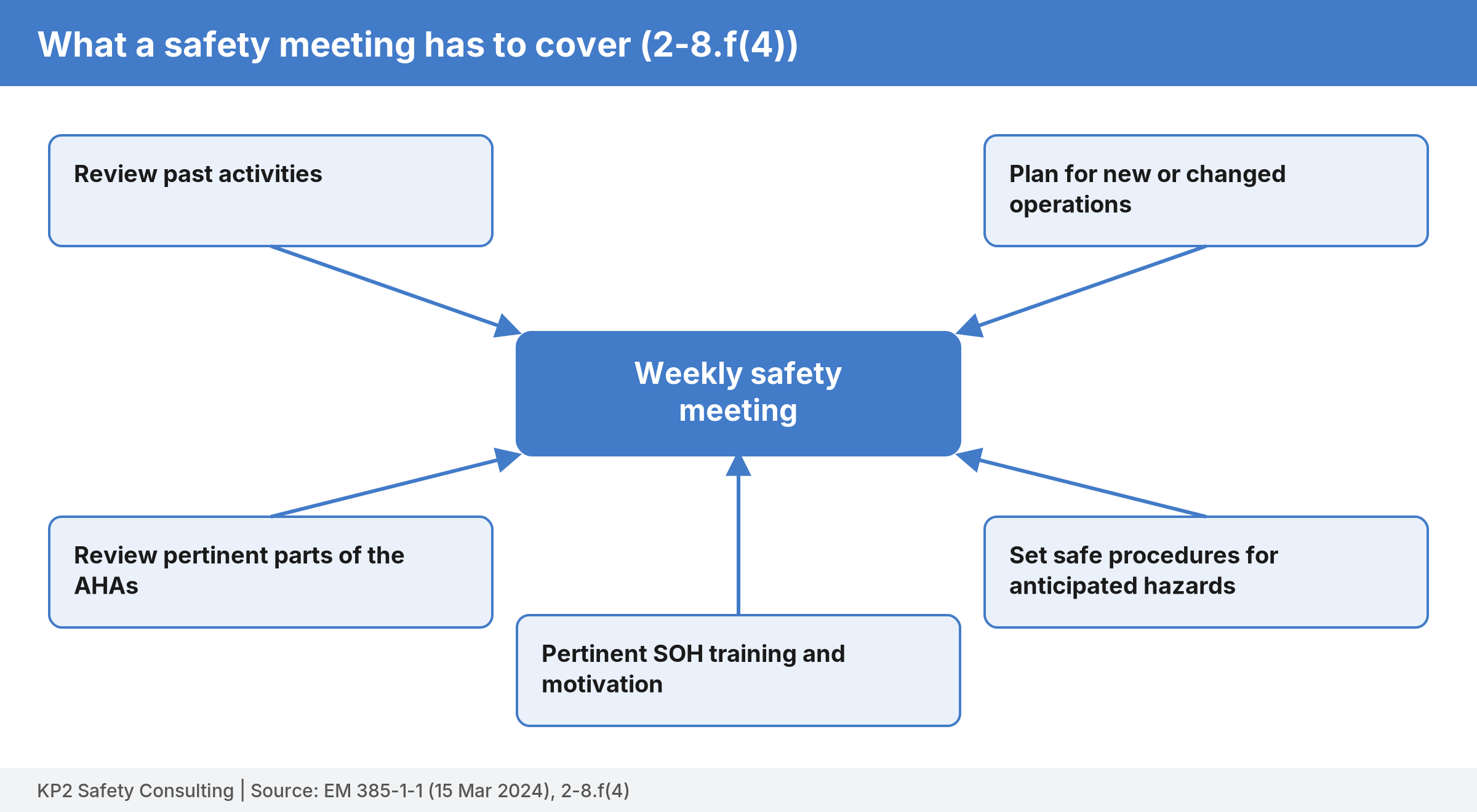
Paragraph 2-8.f(4) says safety meetings must be held on project sites to review past activities, plan for new or changed operations, review pertinent parts of the appropriate AHAs, establish safe working procedures for anticipated hazards, and provide pertinent safety and health training and motivation. Figure 1 shows those five purposes. A good weekly talk touches at least one of them, and over a month it should hit all five. The prime contractor is responsible for conducting and documenting these meetings (2-4.g(12)).
Daily Pre-Task Plan vs. Weekly Toolbox Talk
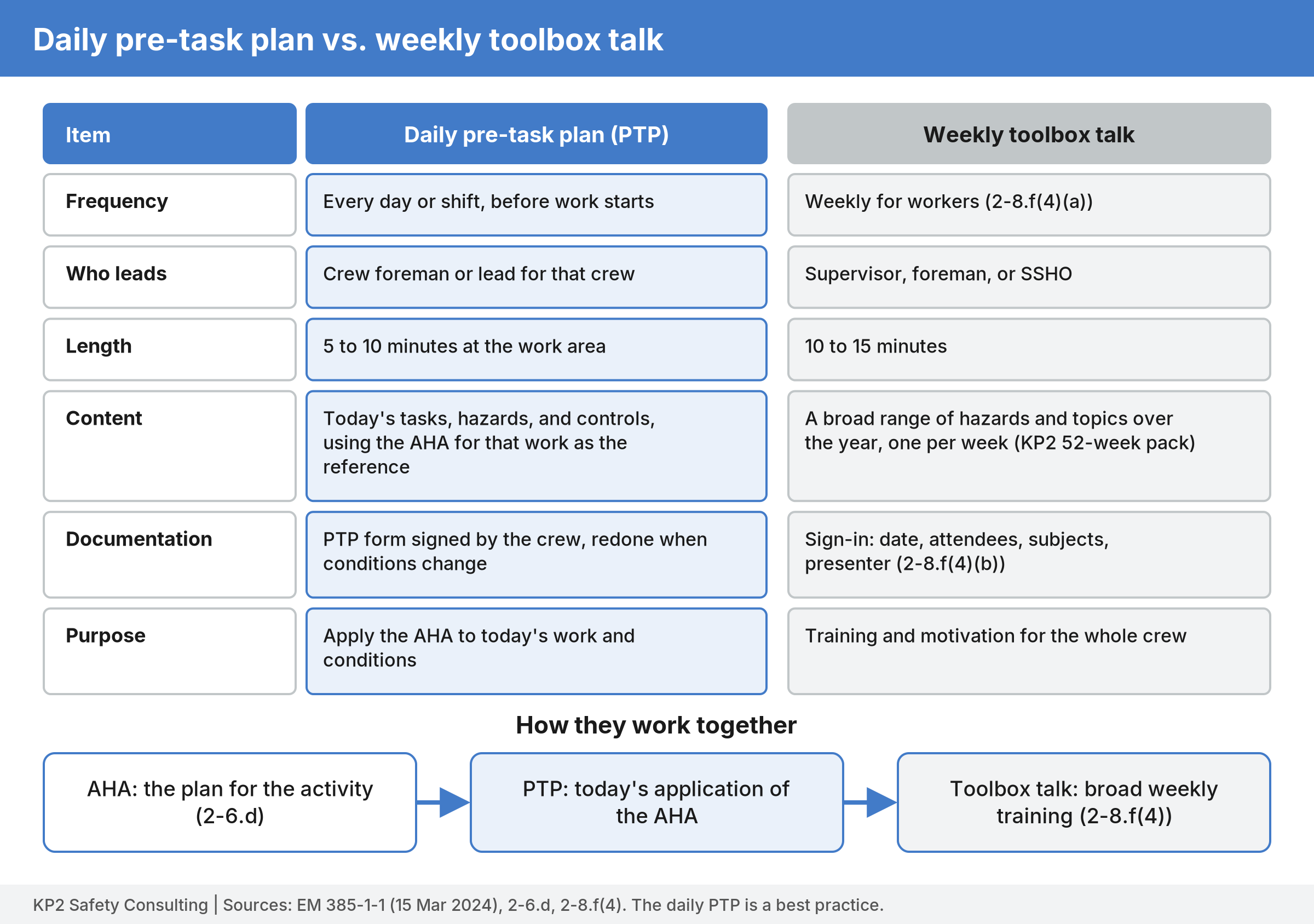
A question I hear on almost every new USACE job is whether the weekly toolbox talk takes the place of the daily pre-task plan, or PTP. It does not, because the two do different jobs. The PTP happens every day or shift before work starts, and the crew foreman leads it right at the work area. It covers that day's specific tasks, the hazards that come with them, and the controls the crew will use, all tied back to the accepted AHA for the activity. The crew signs it, and when conditions change during the shift, such as new weather, a different piece of equipment, or another trade moving in next to you, the foreman stops and revisits it. For a full side-by-side of toolbox talks, daily pre-task plans and safety stand-downs, including orientation and incident briefings, see Toolbox Talk vs. Pre-Task Plan vs. Safety Stand-Down.
To be accurate about the rules, EM 385-1-1 does not require a daily PTP by name, and neither does OSHA. What EM 385-1-1 does require is that every involved employee review the AHA and document that review with a signature before starting the task (2-6.d(2)), that crews have the current AHA reflecting current site conditions while the work is being performed (2-6.d(3)), and that the AHA be updated as site conditions or operations change (2-6.d(5)). The daily PTP is a widely used best practice, and many primes require it from their subs, because it is the most practical way I know to meet those AHA requirements on the ground every single day.
That is why the daily PTP uses the AHA as its reference: the AHA covers the specific work the crew is doing that day, so it is the right tool for talking through today's hazards and controls. The toolbox talk is the weekly safety meeting required by 2-8.f(4), and it does a different job. Over the course of a year it should cover a broad range of hazards and topics, from fall protection and struck-by to heat illness and hazardous energy, which is exactly how I laid out the KP2 52-Week Toolbox Talk Pack. Each talk builds training and motivation across the whole crew and gets documented on a sign-in sheet. The way I explain it to foremen is simple: the AHA is the plan for the activity, the PTP is how you apply that plan to today's work, and the toolbox talk is the weekly training that keeps everyone sharp. Figure 2 compares the two side by side. If you are still sorting out the difference between an AHA and a JHA, read AHA vs JHA: what is the difference.
How Often: Weekly for Workers, Monthly for Supervisors
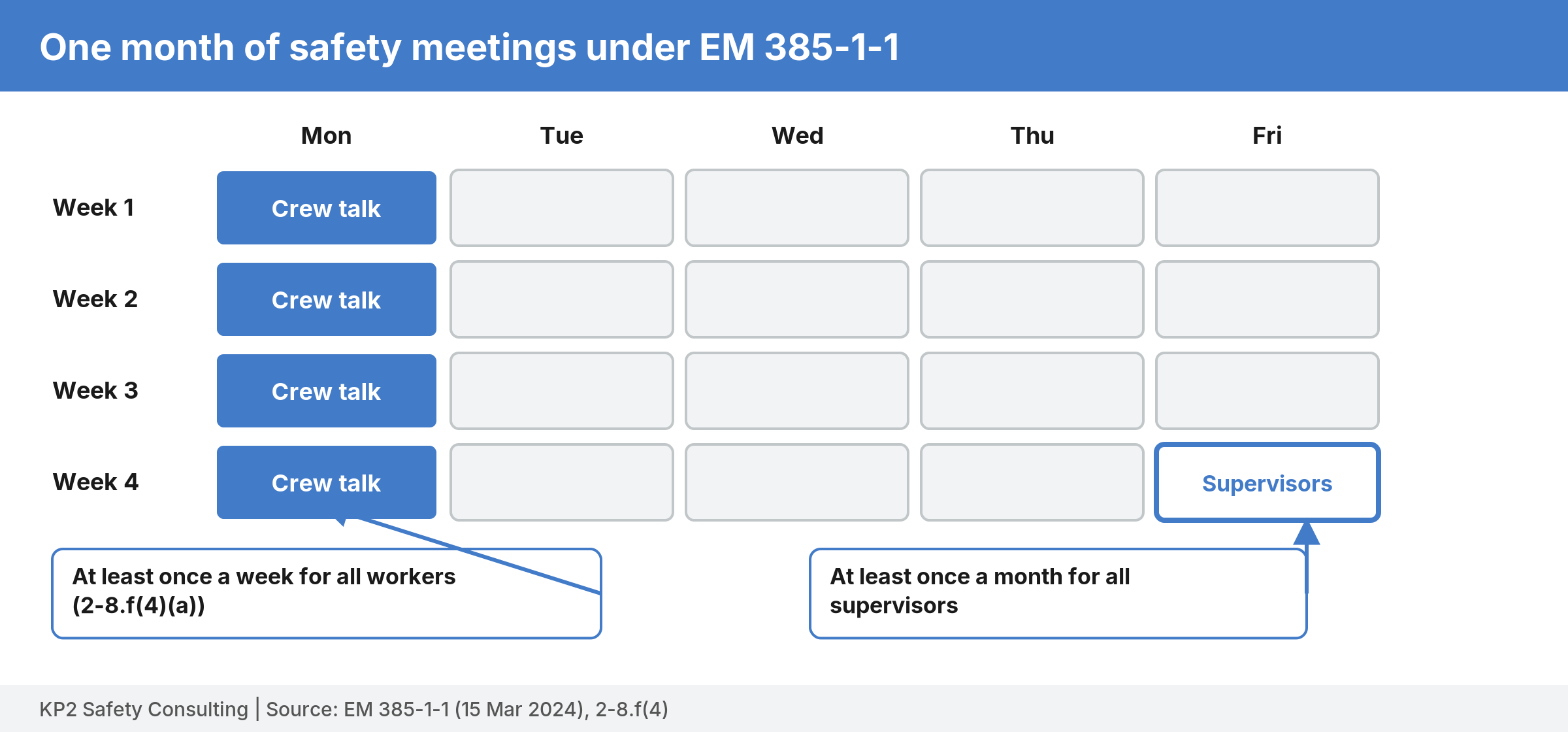
The schedule is in 2-8.f(4)(a): meetings must be held at least once a month for all supervisors on the project and at least once a week for all workers. Figure 3 shows one month. Most contractors pick a set day, often the first day of the work week, so nobody has to remember. The callout arrows point to the two minimums.
What to Document
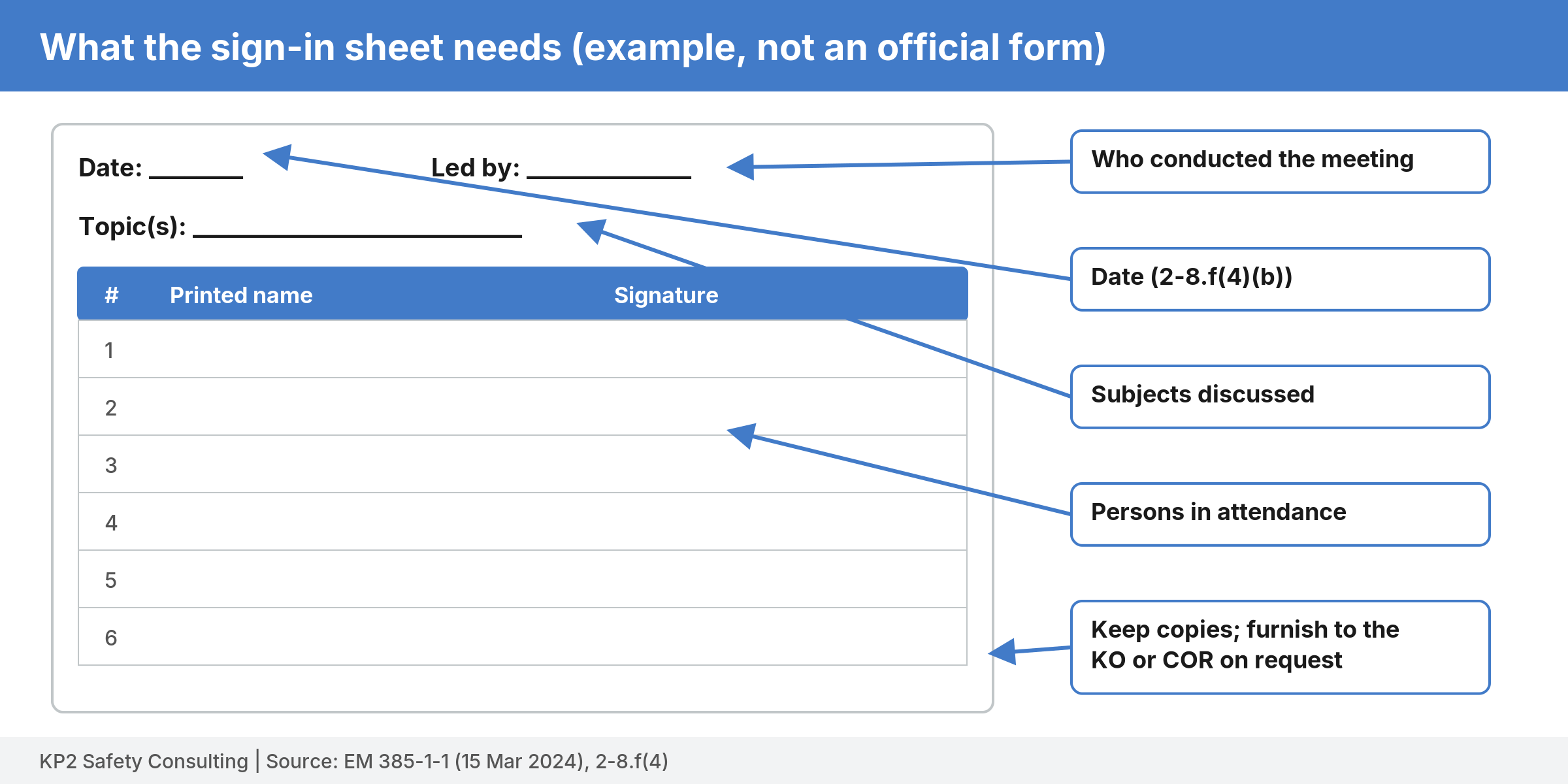
A talk that is not written down is hard to prove. Under 2-8.f(4)(b), document each meeting with the date, the persons in attendance, the subjects discussed, and the name of whoever conducted it. Keep that documentation and furnish copies to the KO or COR on request. Paragraph 2-8.f(4)(c) adds one more step that many contractors miss: invite the KO or COR to all scheduled meetings, with enough advance notice. Figure 4 shows a sign-in sheet with arrows to each required item.
How This Compares to OSHA
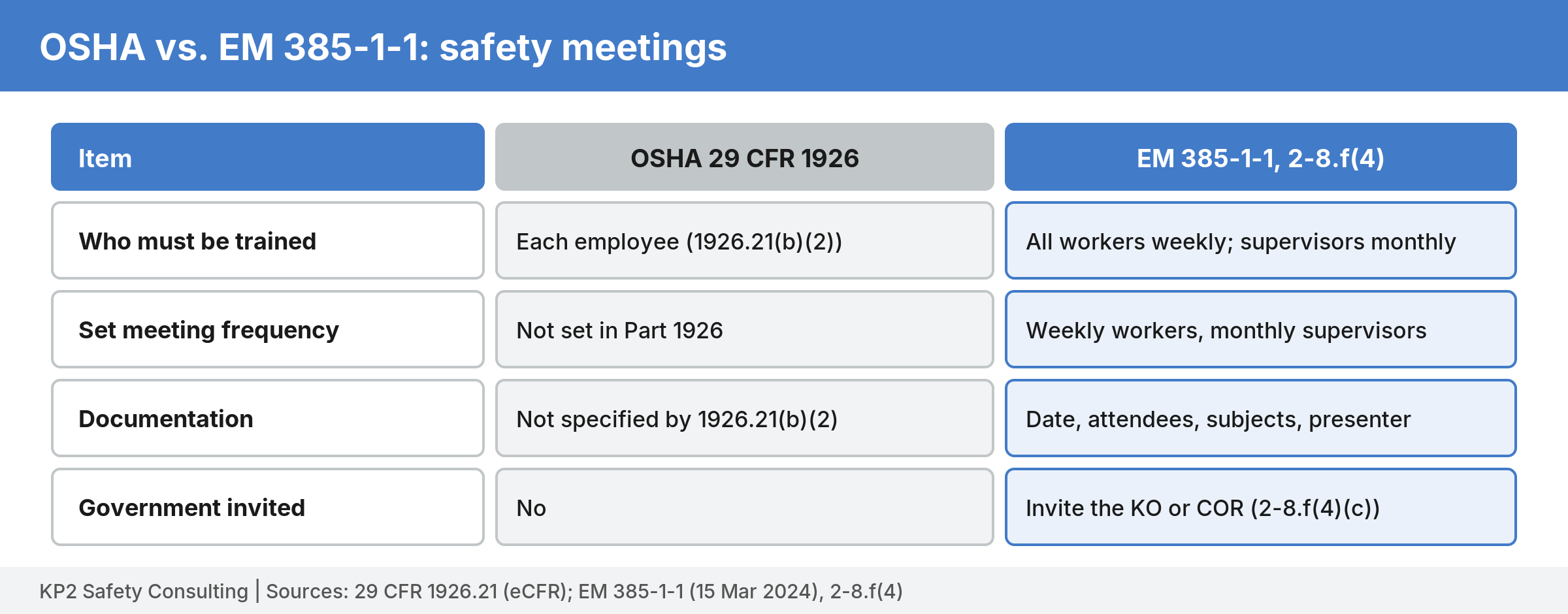
OSHA requires employers to instruct each employee in the recognition and avoidance of unsafe conditions and the regulations that apply to their work (1926.21(b)(2)). Part 1926 does not set a weekly meeting schedule or say what to document for that instruction, and it does not ask you to invite anyone from the government. Figure 5 shows the comparison row by row. If your company already runs weekly talks for OSHA work, you are most of the way there. You mainly need to tighten up the paperwork and send the invite. For the bigger picture, read OSHA vs EM 385-1-1: the key differences contractors miss.
How to Run a 10 to 15 Minute Talk
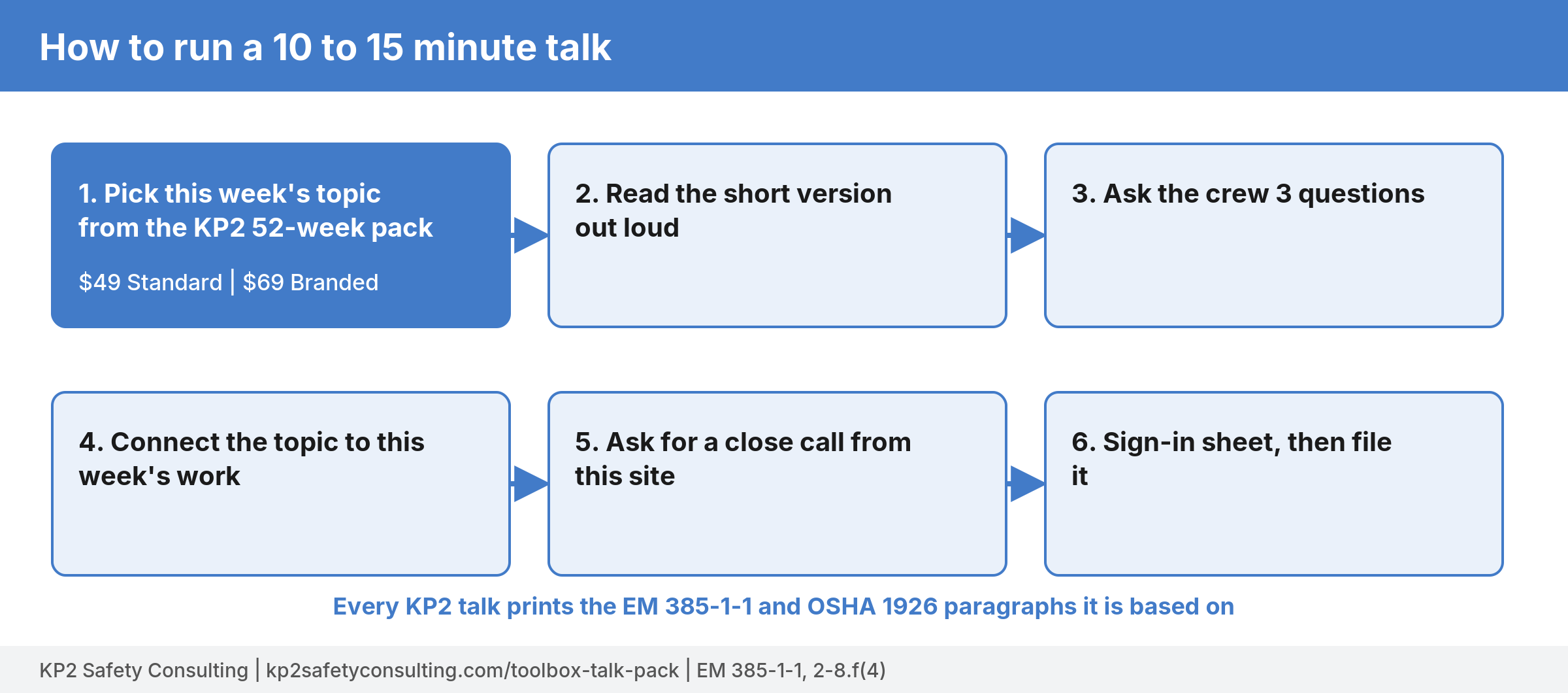
Here is the format I recommend, shown in Figure 6, and it is the same flow every talk in the KP2 pack is built around.
- Pick this week's topic from the KP2 52-Week Toolbox Talk Pack. Every talk prints the EM 385-1-1 and OSHA 1926 paragraphs it is based on, so you are not writing anything from scratch on a Sunday night. Standard is $49, Branded with your logo is $69, and it is free for KP2 fractional safety clients.
- Read the short version out loud so the main point lands even if the talk gets cut short.
- Ask the crew three questions and let them answer. A talk that is only reading gets tuned out.
- Connect the topic to the work your crew is doing this week. The detailed AHA review belongs in the daily pre-task plan, since EM 385-1-1 requires every involved employee to review and sign the AHA before starting the task (2-6.d(2)).
- Ask for a close call from this site, and write it down.
- Get the sign-in sheet filled out and file it.
Plan the Year, Then Adjust to the Work
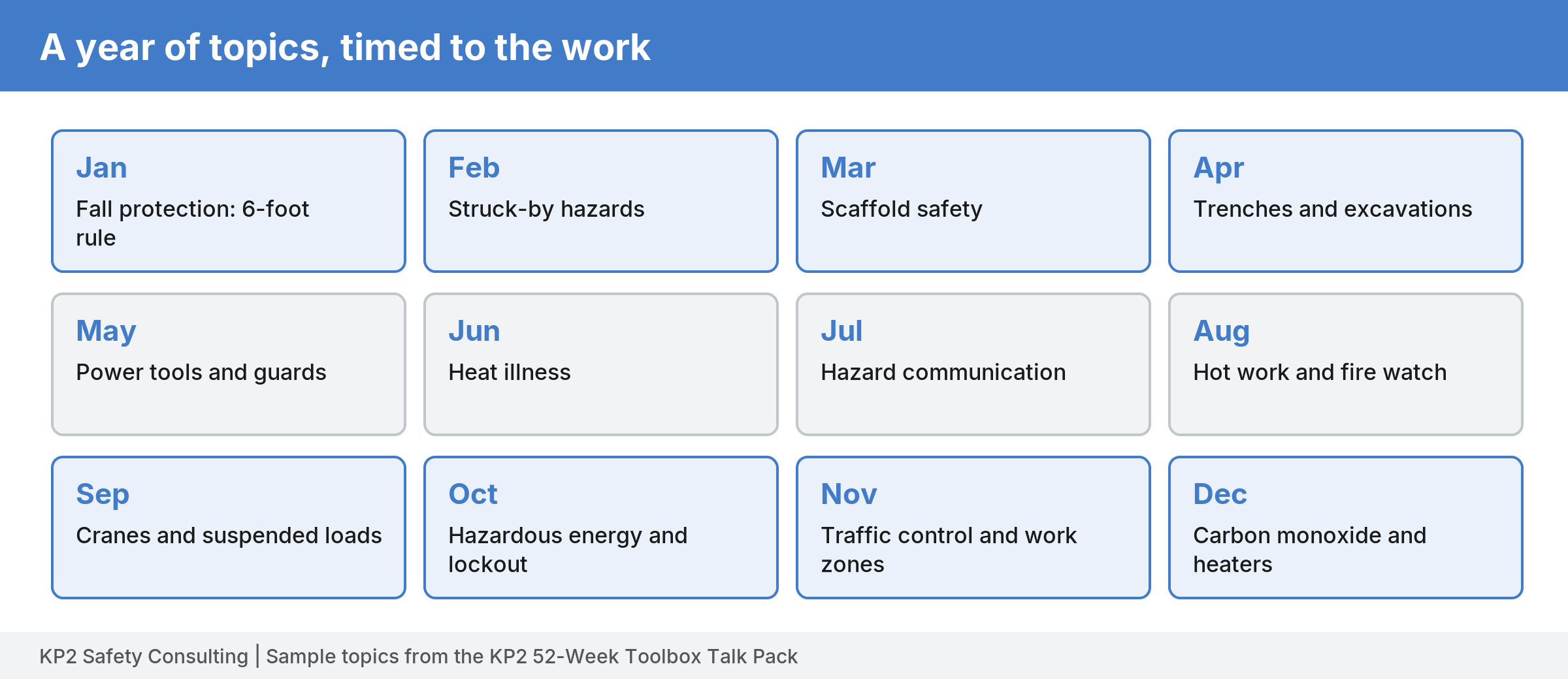
Fifty-two talks is a lot to write from scratch. Plan them around the calendar: cold and ice in the winter, heat in the summer, and the work you know is coming, like excavation or steel. Then swap any week to match what your crew is actually doing. Figure 7 shows one topic per month from the KP2 pack as a starting point.
The KP2 52-Week Toolbox Talk Pack
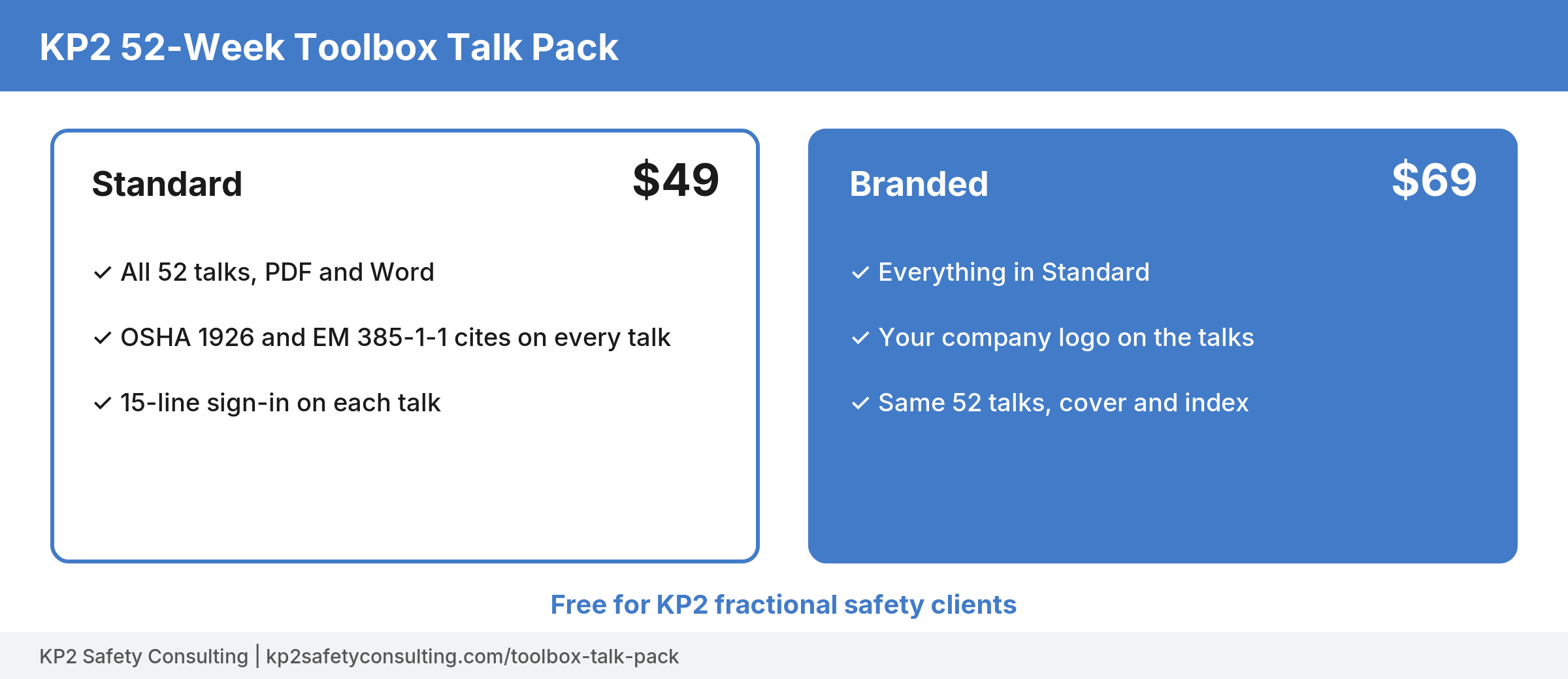
I built the KP2 52-Week Toolbox Talk Pack for crews on USACE and federal jobs as well as commercial work. Every talk prints the EM 385-1-1 and OSHA 1926 paragraphs it is based on, so it supports the 2-8.f(4) meeting and your training records at the same time. Each talk is two pages with a short read-aloud version, crew questions, a close call box, a quick quiz, and a 15-line sign-in sheet that captures the date, presenter, project, and attendees. It comes as PDF and Word. Figure 8 shows the two versions: Standard is $49, and Branded with your company logo is $69. If you are a fractional safety client, the pack is included free.
If you want next Monday's talk printed and ready before the crew shows up, get the KP2 52-Week Toolbox Talk Pack and you will have the whole year covered in one download. For the AHAs your daily pre-task plans point back to, download a free sample AHA or browse the KP2 AHA Library. Questions? Email [email protected] or call the office at 410-216-4424.