
Toolbox Talk vs. Pre-Task Plan vs. Safety Stand-Down: Which One Does Your Crew Need Today?
It is 6:45 on a Monday. Your foreman has a crew of twelve, a sign-in sheet, and fifteen minutes before the excavator starts. Is this the weekly toolbox talk, the daily pre-task plan, or the stand-down the GC called after Friday's near miss? If the answer is "all three on one sheet," you are not alone, and you are also handing a USACE reviewer an easy finding.
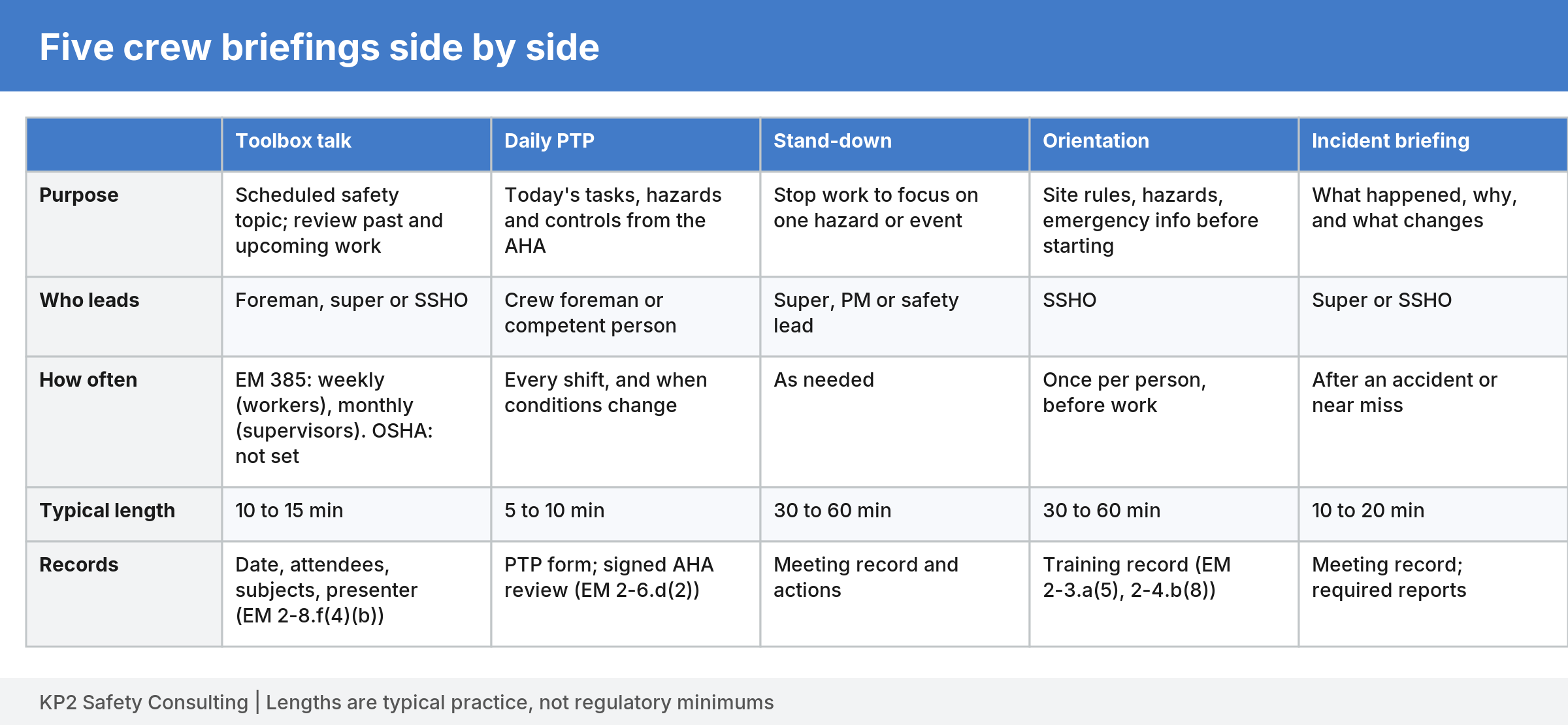
I review a lot of safety submittals and field records on federal and commercial construction jobs, and mixing up these meetings is one of the most common gaps I see. Each one has its own purpose, leader, schedule and paperwork. This article lines them up side by side, adds two shorter sections on new-hire site orientation and incident or lessons-learned briefings, and shows where OSHA 29 CFR 1926 and USACE EM 385-1-1 (15 March 2024 edition) say different things. Here is the short answer, and Figure 1 is the one-page version.
- A toolbox talk is a scheduled safety meeting on a topic. Under EM 385-1-1 it is the weekly safety meeting in paragraph 2-8.f(4).
- A daily pre-task plan (PTP) is the crew's review of today's work, hazards and controls, tied to the accepted Activity Hazard Analysis (AHA).
- A safety stand-down is an unscheduled pause in work to deal with one hazard or event, often after an incident or a stop-work.
- New-hire site orientation happens once per person, before they start work on the site.
- An incident or lessons-learned briefing shares what happened, why, and what changes, soon after an accident or near miss.
None of the five replaces another. Figure 8, near the end, gives you a quick way to pick the right one.
Toolbox Talks
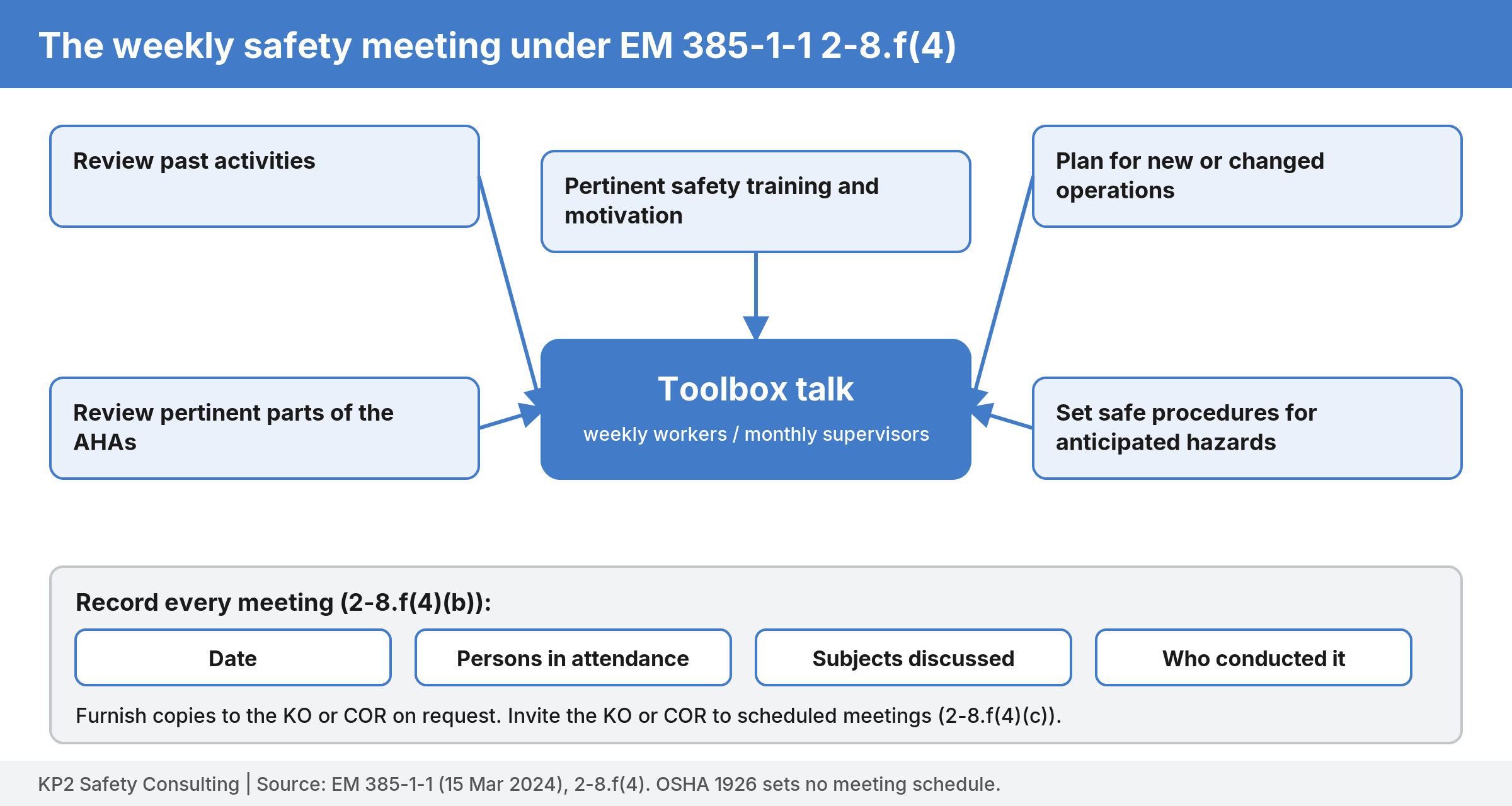
Purpose. EM 385-1-1 paragraph 2-8.f(4) says safety meetings must be held on project sites to review past activities, plan for new or changed operations, review pertinent aspects of appropriate AHAs, set safe working procedures for anticipated hazards, and provide pertinent safety and health training and motivation. Figure 2 shows those five jobs around the meeting.
Who leads. Usually the foreman, superintendent or Site Safety and Health Officer (SSHO). Under 2-4.g(12) the prime contractor must conduct and document the meetings, and under 2-4.b(5) the SSHO attends tail-gate and pre-work meetings.
How often. EM 385-1-1 2-8.f(4)(a): at least once a week for all workers and at least once a month for all supervisors. OSHA 1926 sets no meeting frequency. 1926.21(b)(2) requires the employer to instruct each employee in recognizing and avoiding unsafe conditions and the regulations that apply to their work, and 1926.20(b)(1) requires accident prevention programs, but neither names a schedule.
How long. No rule sets a length. Ten to fifteen minutes is typical and keeps attention.
Documentation. EM 385-1-1 2-8.f(4)(b): the date, persons in attendance, subjects discussed, and names of whoever conducted the meeting, with copies furnished to the KO or COR on request. Under 2-8.f(4)(c), invite the KO or COR to all scheduled meetings with enough advance notice. OSHA 1926 does not prescribe a sign-in format for this instruction.
When to use it. Every week, on a set day, on a topic that matches the work coming up. My longer guide, Toolbox Talks Under EM 385-1-1, covers how to run one.
Daily Pre-Task Plans (PTPs)
Purpose. The PTP brings the AHA down to today: this crew, this location, this equipment, these conditions. It is where the crew confirms the controls before the first cut, lift or pour.
Who leads. The crew foreman or competent person at the work area, with the crew participating.
How often. Every shift before work starts, and again whenever the task or conditions change.
How long. Typically five to ten minutes at the work face.
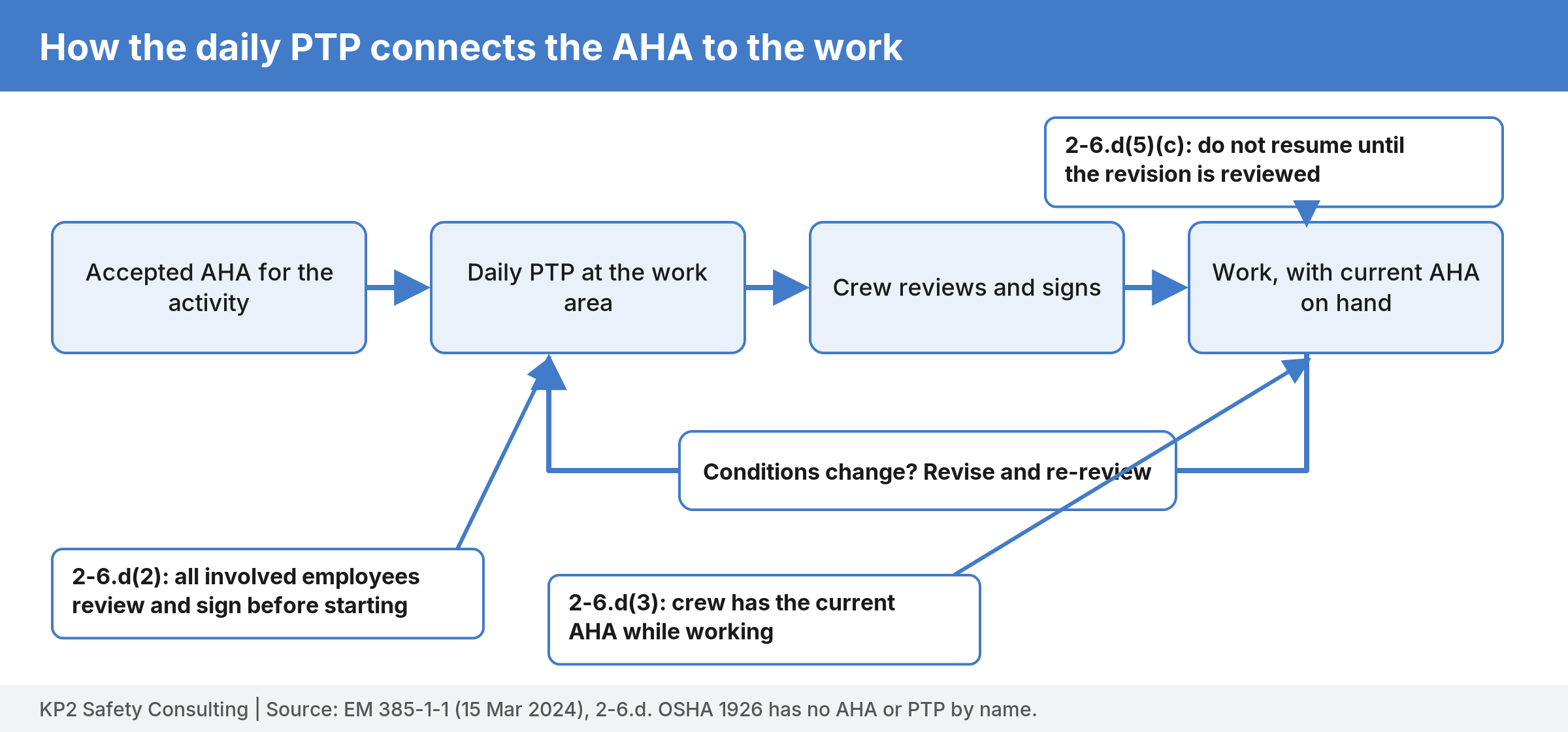
Documentation. A PTP form with the tasks, hazards, controls and crew signatures is common practice. Neither OSHA nor EM 385-1-1 requires a form called a "PTP." What EM 385-1-1 does require is the AHA work it supports. Under 2-6.d(2), AHAs must be provided to and reviewed by all involved employees before starting the task, and each employee documents the review with a signature on the AHA or a signature sheet. Under 2-6.d(3), crews must have in their possession the current AHA that reflects current site conditions, personnel, equipment and controls while the work is being performed. Many crews use the daily PTP to meet those two requirements.
When to use it. Every day. Figure 3 shows how it connects the accepted AHA to the work. If the AHA must be revised, 2-6.d(5)(c) says work should not resume until the revision is complete and reviewed by all involved employees.
Regulatory basis. EM 385-1-1 2-6.d(1) requires an AHA before each work activity, task or definable feature of work. OSHA 1926 has no AHA or PTP requirement by name. The closest general duties are 1926.20(b)(2), frequent and regular inspections by competent persons, and 1926.21(b)(2). Need a starting AHA? Browse the KP2 AHA Library or download the free sample AHA.
Safety Stand-Downs
Purpose. A stand-down stops work so everyone on the site, or a whole trade, focuses on one hazard or event. OSHA describes a safety stand-down as "a voluntary event for employers to talk directly to employees about safety."
Who leads. Usually the superintendent, project manager or safety lead, often with company leadership present.
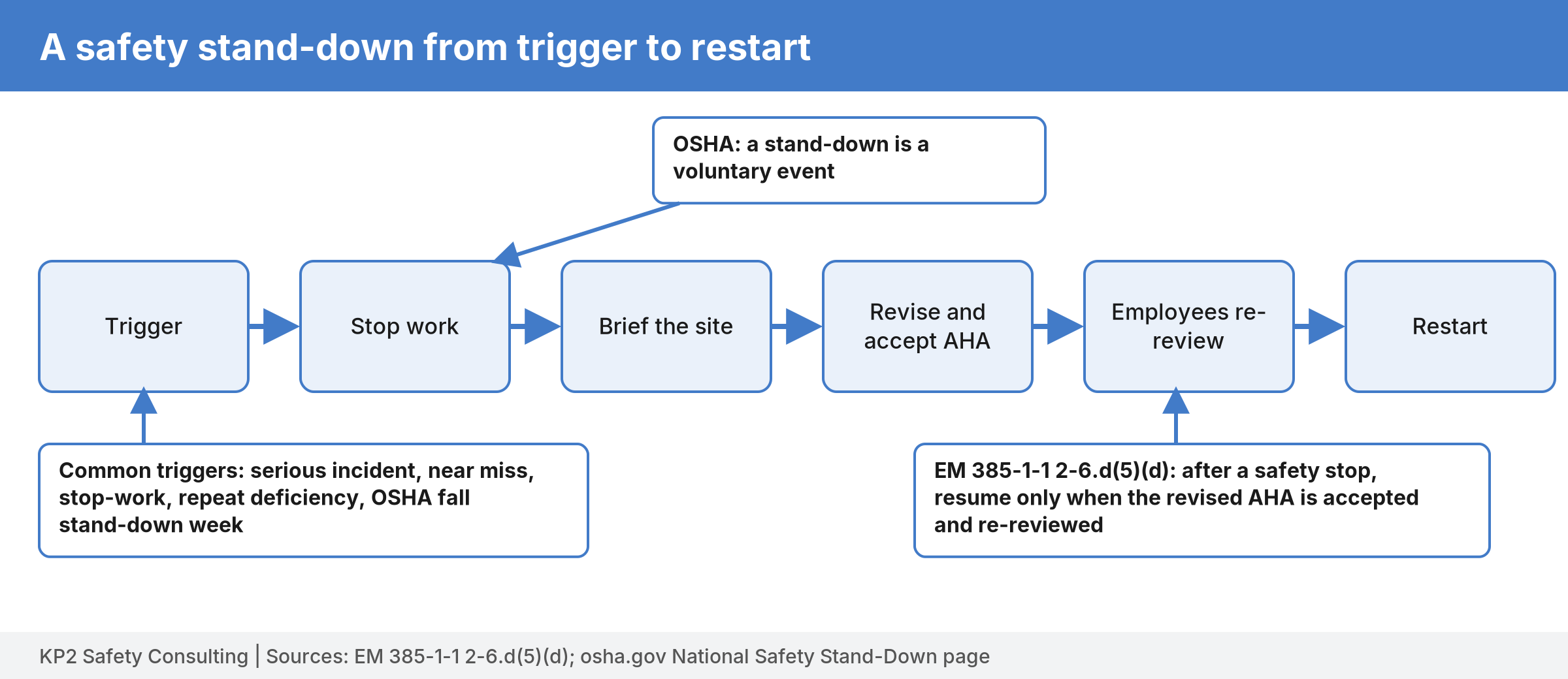
How often. As needed. Common triggers are a serious incident or near miss, a stop-work, a pattern of the same deficiency, or a campaign such as OSHA's National Safety Stand-Down to Prevent Falls in Construction, which OSHA lists for May 4 to 8, 2026.
How long. Commonly 30 minutes to an hour, sometimes longer. No rule sets a length.
Documentation. Treat it like any safety meeting: date, attendees, topic, presenter, and the corrective actions agreed. On an EM 385-1-1 job I recommend logging it with your 2-8.f(4)(b) meeting records.
Regulatory basis. Neither OSHA 1926 nor EM 385-1-1 requires a stand-down by name; OSHA's national event is voluntary. EM 385-1-1 does set a related rule: under 2-6.d(5)(d), if work was stopped for safety non-compliance and the AHA needs revising, work should not resume until the revision is complete and accepted and employees have re-reviewed it. A stand-down is a natural place to do that re-review. Figure 4 shows the flow.
New-Hire Site Orientation
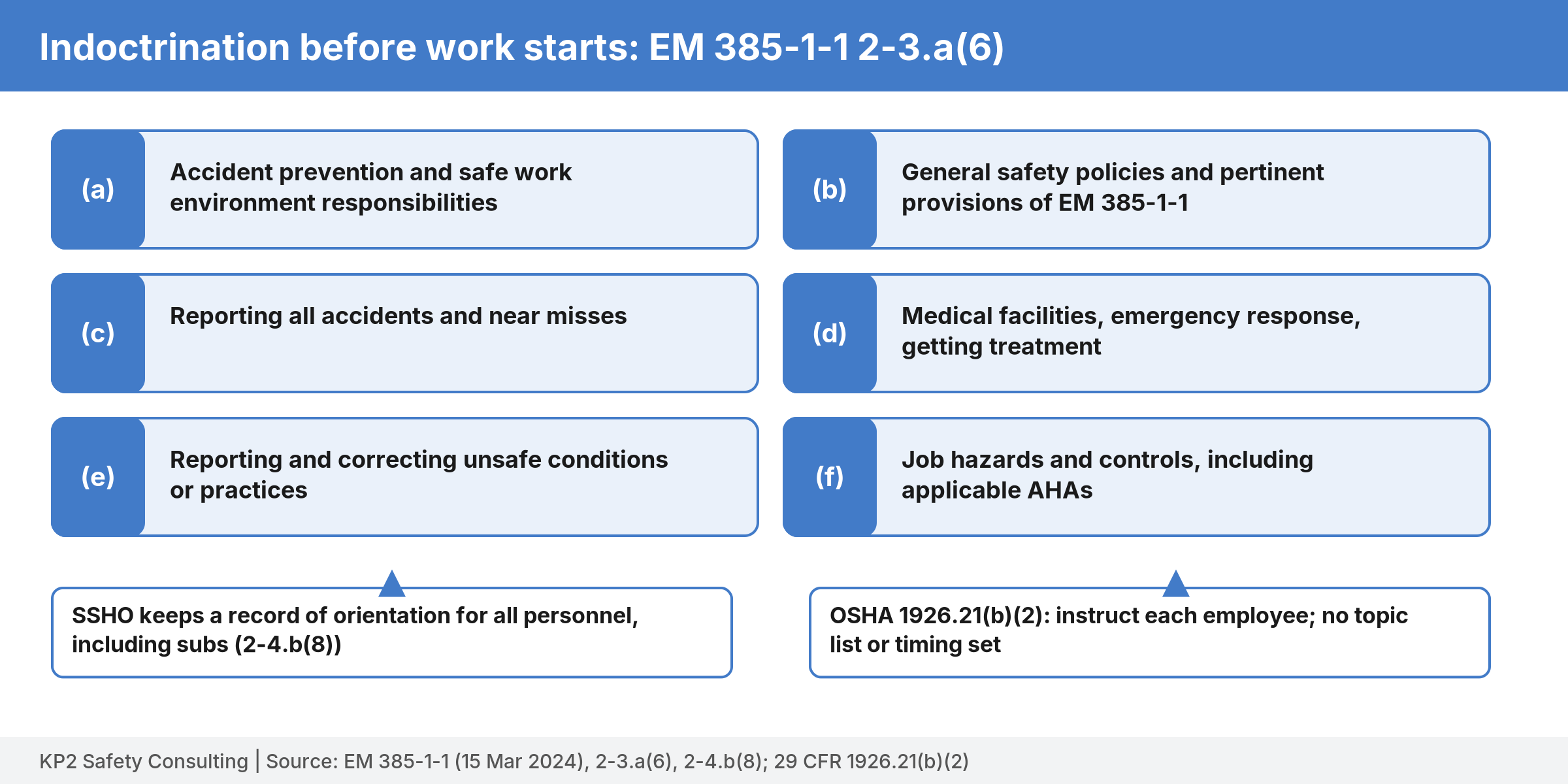
Purpose, timing and leader. Orientation happens once per person, before they start work on this site, and is usually run by the SSHO. EM 385-1-1 2-3.a(6) requires indoctrination training before the start of work covering six items, shown in Figure 5: accident prevention responsibilities; general safety policies and the pertinent provisions of the manual; reporting all accidents and near misses; medical facilities and emergency procedures; reporting and correcting unsafe conditions; and job hazards and their controls, including applicable AHAs.
Length and documentation. Length depends on the site; 30 to 60 minutes is common. Under 2-4.b(8) the SSHO must keep a record of site safety orientation and indoctrination for all project personnel, including subcontractors, and 2-3.a(5) lists what training records include, such as date, location, duration, trainer, materials, participants, and an evaluation result. Under 2-8.f(5), signs at site entrances must tell anyone entering to report to the project office for a safety briefing.
OSHA basis. 1926.21(b)(2) requires the instruction but does not set a timing, content list or record format for it.
Incident and Lessons-Learned Briefings
Purpose and leader. After an accident or near miss, the superintendent or SSHO tells the crew what happened, the causes found so far, and what changes now. Keep it factual and blame-free. EM 385-1-1 2-8.d calls accident and near miss reporting and investigation a leading indicator, and the weekly meeting already exists to "review past activities" (2-8.f(4)).
When and how long. As soon as the facts are clear enough to share, usually within a day or two. Ten to twenty minutes is typical. Document it like a safety meeting.
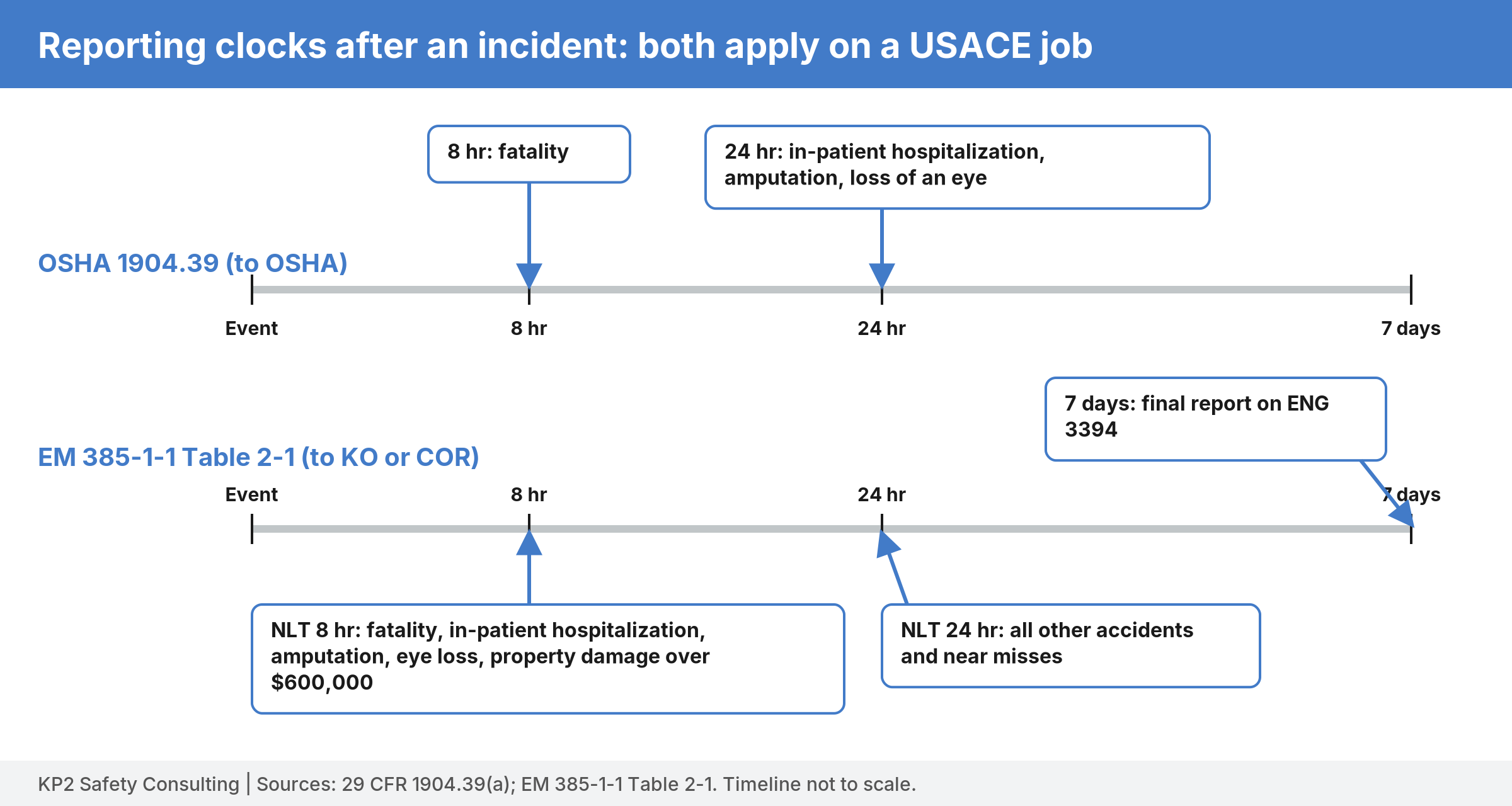
Reporting clocks. The briefing does not replace the required reports, and here the two rulebooks set different clocks, shown in Figure 6:
- OSHA 1904.39: report a fatality to OSHA within 8 hours; report an in-patient hospitalization, amputation or loss of an eye within 24 hours.
- EM 385-1-1 Table 2-1: notify the KO or COR immediately, no later than 8 hours, for a fatality, in-patient hospitalization, amputation, eye loss, or property damage over $600,000; notify immediately, no later than 24 hours, for all other accidents and near misses; complete the final report on ENG Form 3394 and provide it to the KO or COR within 7 days.
Note that 1904.39 is in Part 1904, OSHA's recordkeeping rule, not Part 1926. On a USACE job, both sets of clocks apply, and they go to different recipients. If you need help with the investigation itself, see KP2 incident investigation support.
Where OSHA and EM 385-1-1 Differ
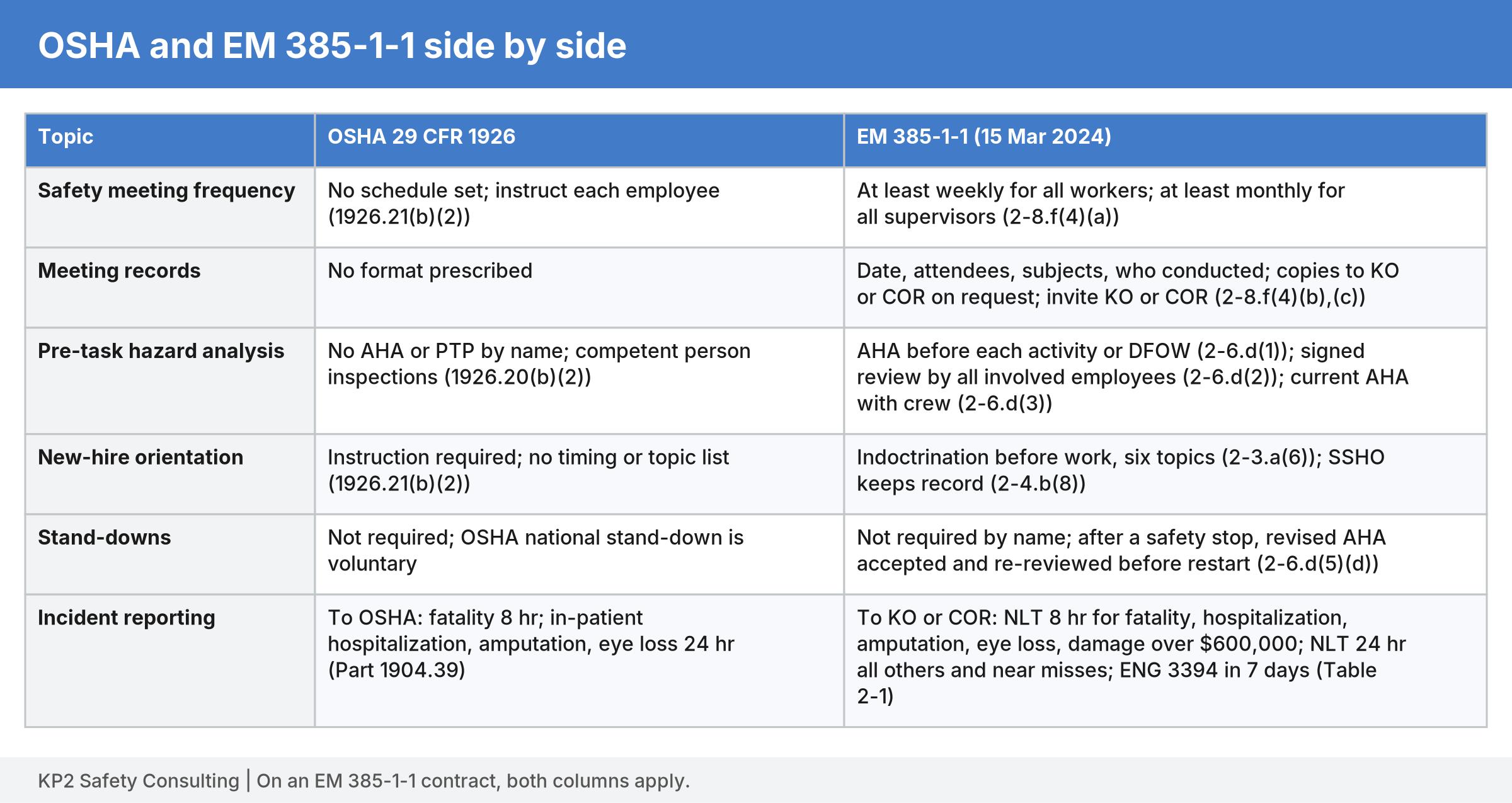
Figure 7 puts both values side by side. On a contract that invokes EM 385-1-1, you follow both, so plan your meetings and paperwork around each column, not just one.
Which Briefing Do I Need Today?
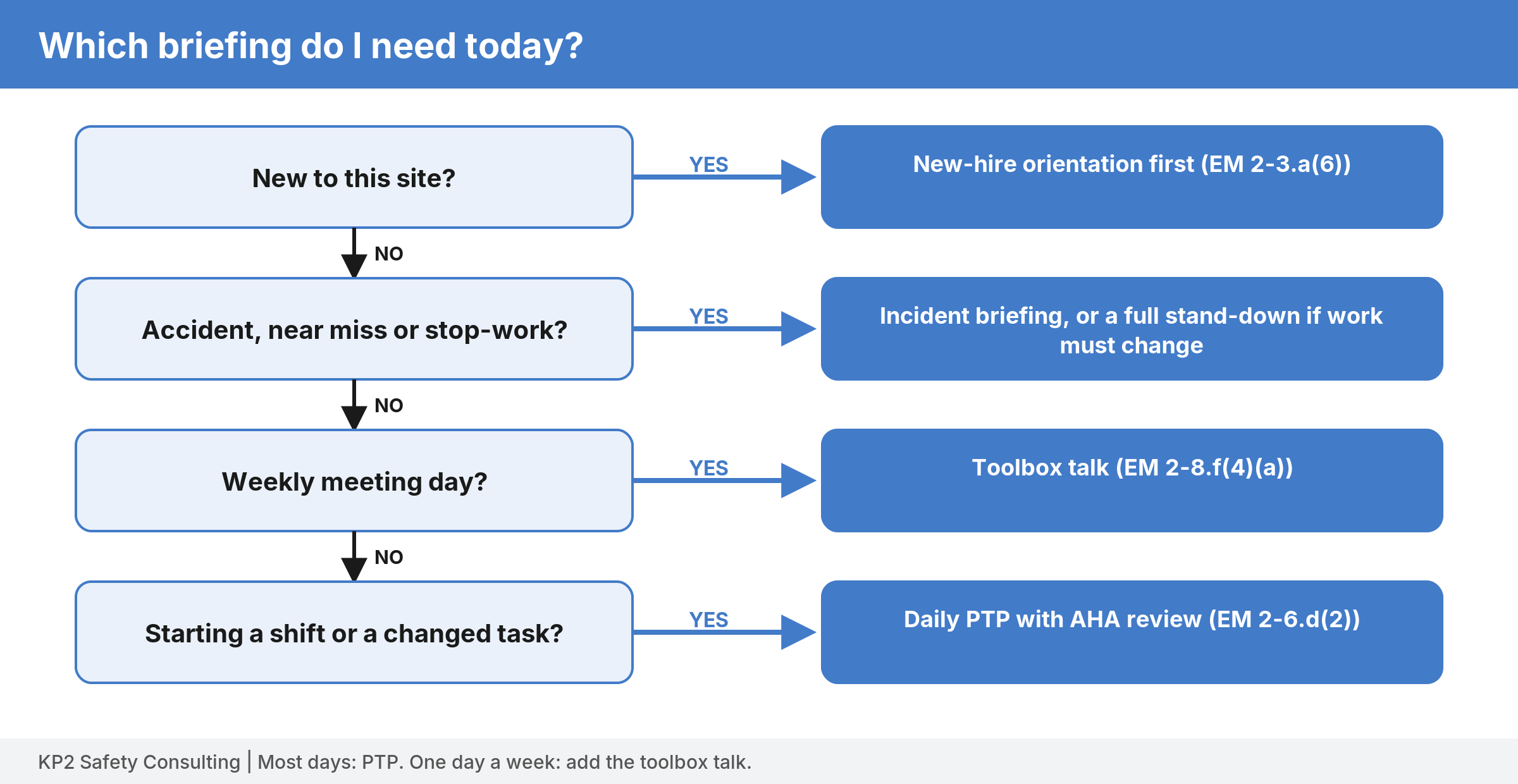
Use Figure 8 at the start of the day. Most days you will run a PTP. One day a week you will add the toolbox talk. New people get orientation first, and an event that changes how the work is done earns an incident briefing or a full stand-down.
Get the Paperwork Off Your Foreman's Plate
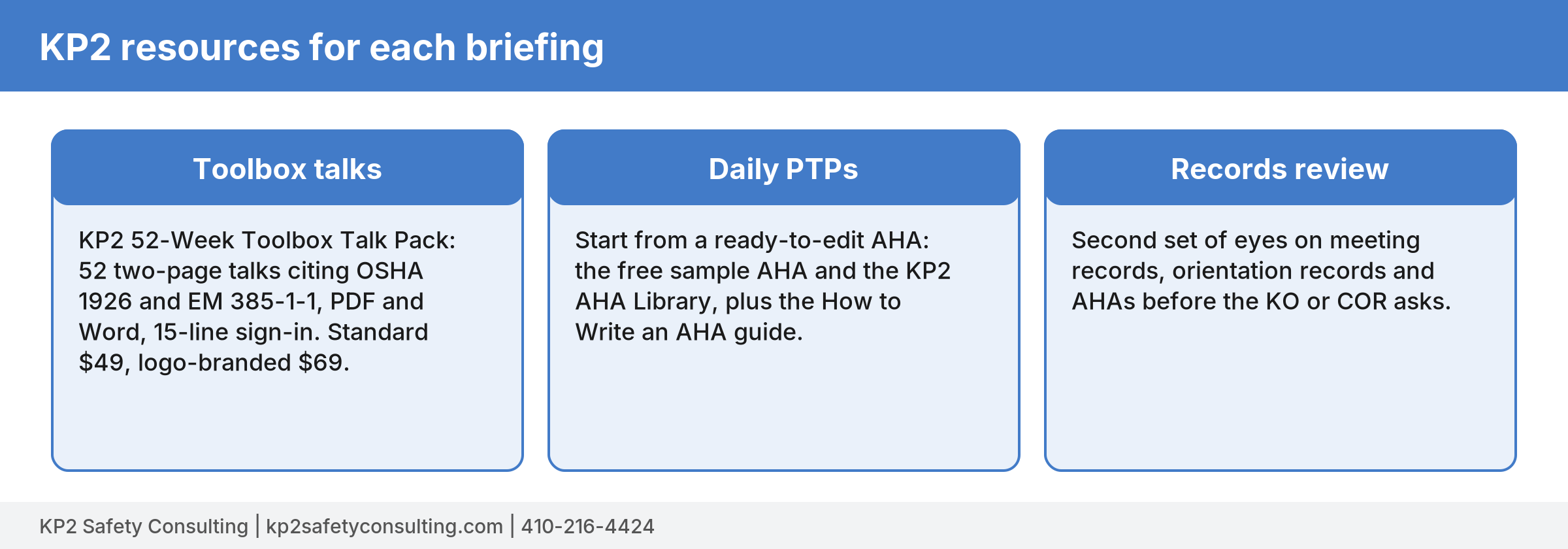
The fastest fix I know for this is to give foremen the right material for each meeting. The KP2 52-Week Toolbox Talk Pack gives you 52 two-page weekly talks that cite OSHA 1926 and EM 385-1-1, each with date, presenter and project blanks and a 15-line attendee roster, so the record lines up with what 2-8.f(4)(b) asks for. It comes in PDF and Word and is $49 for the standard pack or $69 branded with your logo. For the AHAs your PTPs depend on, start with the free sample AHA, browse the KP2 AHA Library, or read How to Write an AHA.
Figure 9 shows where to start.
Want a second set of eyes on your meeting records or AHAs before the KO or COR asks for them? Email [email protected] or call 410-216-4424.