
OSHA vs EM 385-1-1: The Key Differences Contractors Miss
Your crew is on a scaffold 8 feet up with no guardrails and no harnesses. On a private commercial job, OSHA does not require fall protection on that scaffold until the platform is more than 10 feet up. On a Corps of Engineers job, that same setup is a violation the moment it goes past 6 feet. Same crew, same scaffold, two different answers.
That gap is what catches good contractors when they move from commercial work to their first USACE or federal job. They know OSHA well, and they assume EM 385-1-1 is just OSHA with a different cover. It is not. In this article I will walk through the differences I look for most often when reviewing safety submittals, with a graphic for each one, both numbers side by side, and the exact citation so you can check it yourself.
Two Rulebooks, One Job Site: Which One Governs?
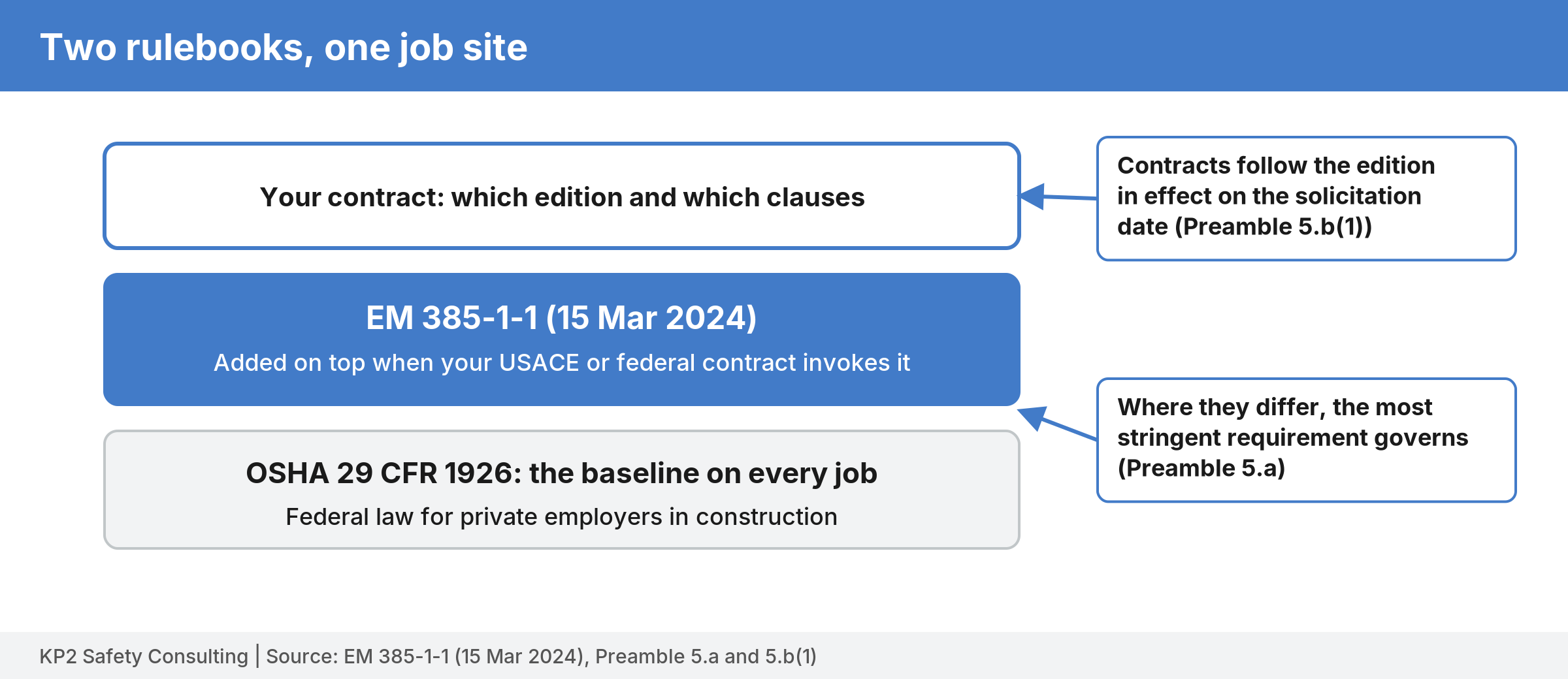
OSHA's construction standards in 29 CFR 1926 apply to private employers on every job. EM 385-1-1, the USACE Safety and Health Requirements Manual, gets added on top when your contract calls for it. The 15 March 2024 edition is clear about what happens when the two disagree: where the requirements vary, the most stringent requirement governs (Preamble, 5.a). Your contract also sets which edition applies, because contracts follow the version in effect on the solicitation date (Preamble, 5.b(1)). Figure 1 shows how the layers stack.
Fall Protection: Where the Numbers Really Differ
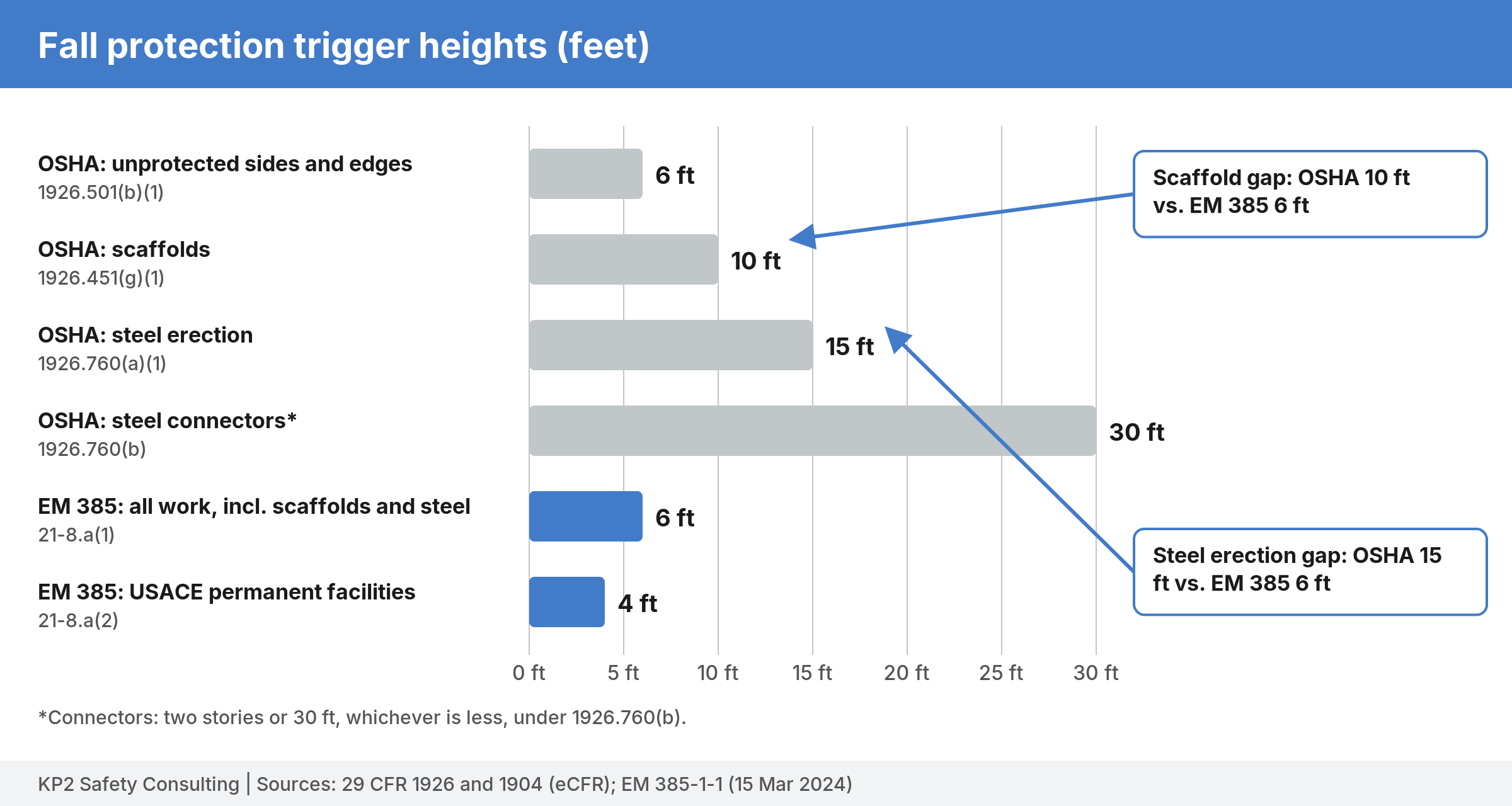
This is the difference that shows up in the field first. Under OSHA, the general trigger for unprotected sides and edges is 6 feet (1926.501(b)(1)), but scaffolds have their own trigger of more than 10 feet (1926.451(g)(1)), and steel erection uses more than 15 feet (1926.760(a)(1)), with connectors allowed up to two stories or 30 feet, whichever is less (1926.760(b)).
EM 385-1-1 sets one number: the fall protection threshold is 6 feet for all work covered by the manual, and it names scaffolding work and steel erection on purpose (21-8.a(1)). On USACE-owned or operated permanent facilities, the threshold for open-sided floors, platforms, and unprotected edges drops to 4 feet (21-8.a(2)). Figure 2 puts every number on one scale. The callout arrows mark the two gaps that cause the most trouble: scaffolds and steel.
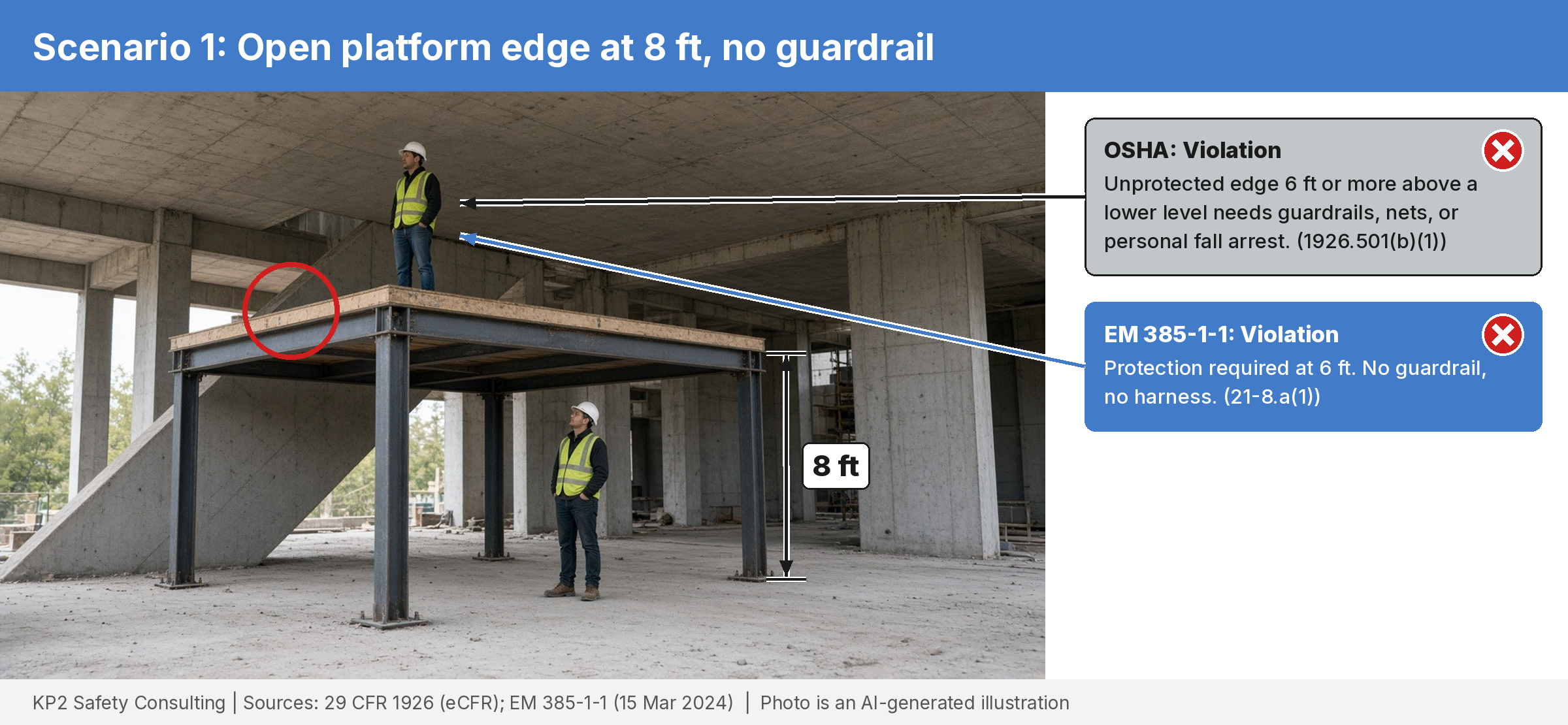
Numbers on a chart are easy to forget, so Figures 3, 4, 5, and 7 put them on a job site. Each photo shows a worker with no fall protection in place, so you can see which rulebook calls it a violation. In Figure 3, a worker stands at the open edge of a platform about 8 feet above the floor, with no guardrail and no harness. This is the one case where the two rulebooks agree: OSHA requires guardrails, safety nets, or personal fall arrest at 6 feet or more (1926.501(b)(1)), and EM 385-1-1 sets its threshold at 6 feet (21-8.a(1)). It is a violation under both.
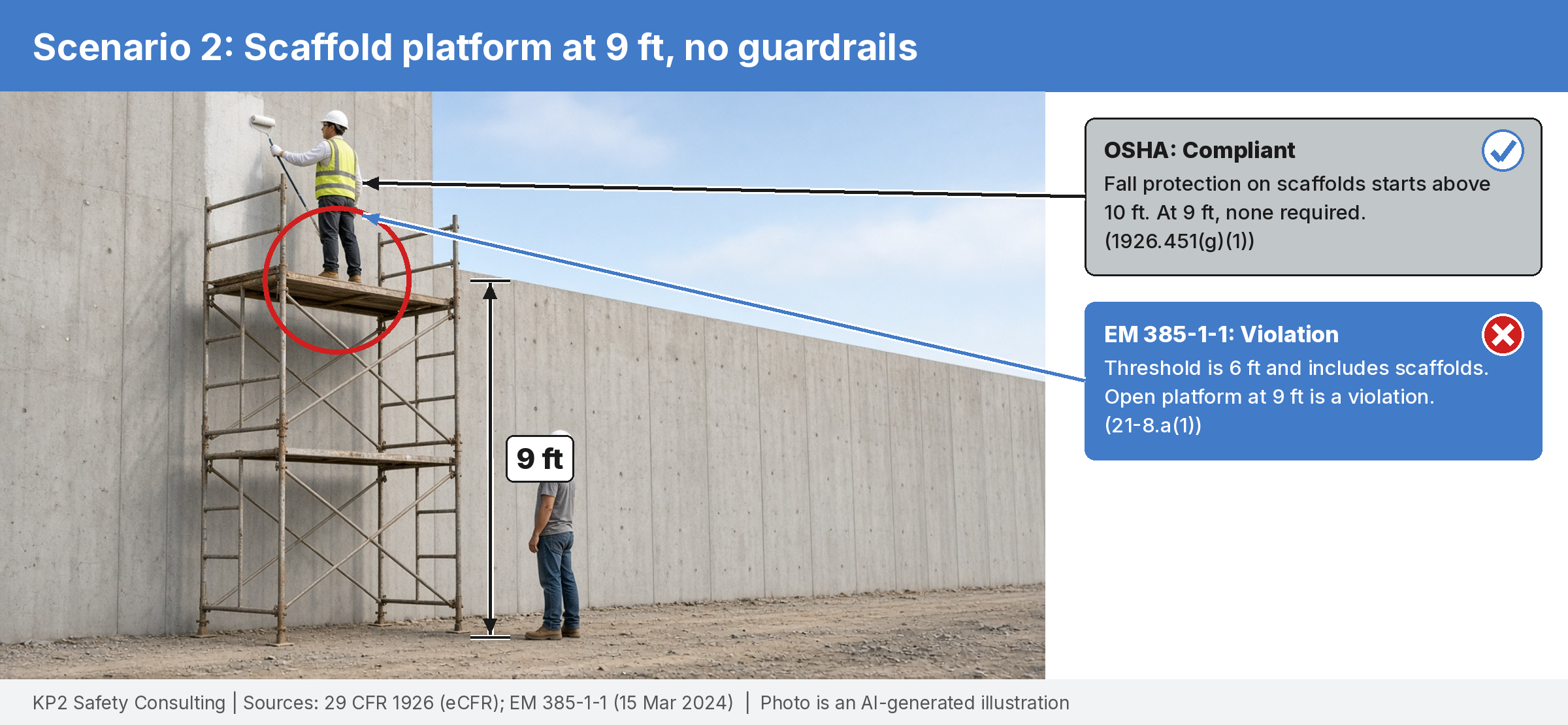
Move that worker onto a scaffold platform 9 feet up with no guardrails, as in Figure 4, and the answers split. OSHA does not require fall protection on a scaffold until it is more than 10 feet above a lower level (1926.451(g)(1)), so this is compliant under OSHA. EM 385-1-1 requires protection at 6 feet and names scaffolding work in the rule (21-8.a(1)), so the same scaffold is a violation on a USACE job.
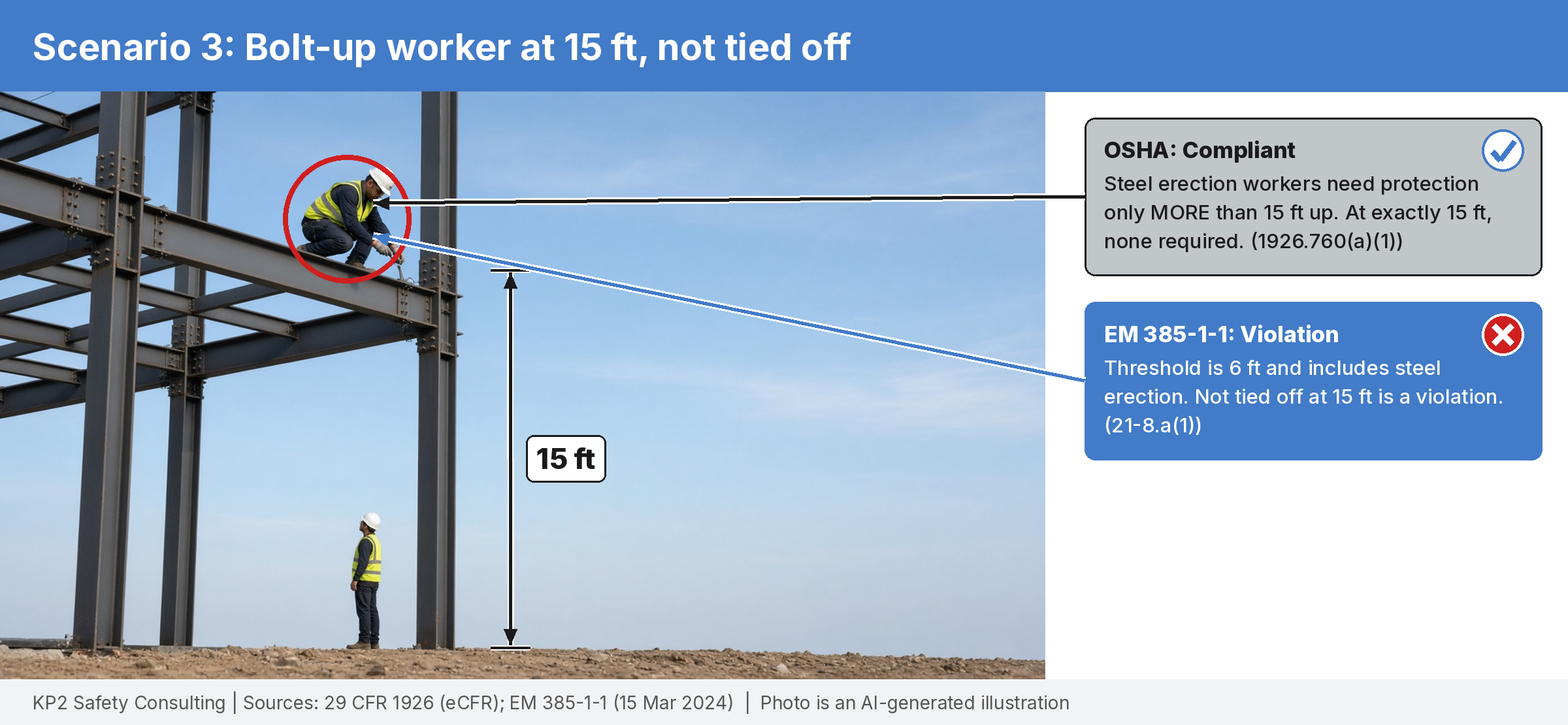
Steel erection is where the difference is biggest, and it comes down to who the worker is. Everyone else on the steel, such as workers bolting up, welding, or laying out, has to be protected once they are more than 15 feet up: guardrails or perimeter safety cables, safety nets, or a personal fall arrest, positioning, or restraint system (1926.760(a)(1)). Figure 5 shows a bolt-up worker at exactly 15 feet who is not tied off. OSHA does not require protection until he is above 15 feet, so this is compliant under OSHA, but it is a violation under EM 385-1-1, whose 6-foot threshold names steel erection (21-8.a(1)). Move him up to 20 feet and he would be in violation under OSHA too.
The connector is the ironworker at the top who, working with the crane, catches each beam and makes the first bolts (1926.751). Constant tie-off gets in the way of that work, so OSHA gives connectors a buffer zone, shown in Figure 6. At 15 feet and below, there is no connector fall protection requirement. Over 15 feet and up to 30 feet, a connector must be provided with a personal fall arrest, positioning, or restraint system and wear the equipment needed to tie off, but does not have to be tied off (1926.760(b)(3)). Above two stories or 30 feet, whichever is less, the connector must be protected, which in practice means tied off (1926.760(b)(1)). So at 20 feet, a bolt-up worker must be protected, but a connector only has to be wearing the gear. EM 385-1-1 removes the buffer: everyone, connectors included, is protected at 6 feet, and connectors stay 100% tied off (21-8.a(1), 21-8.a(3)(d)).
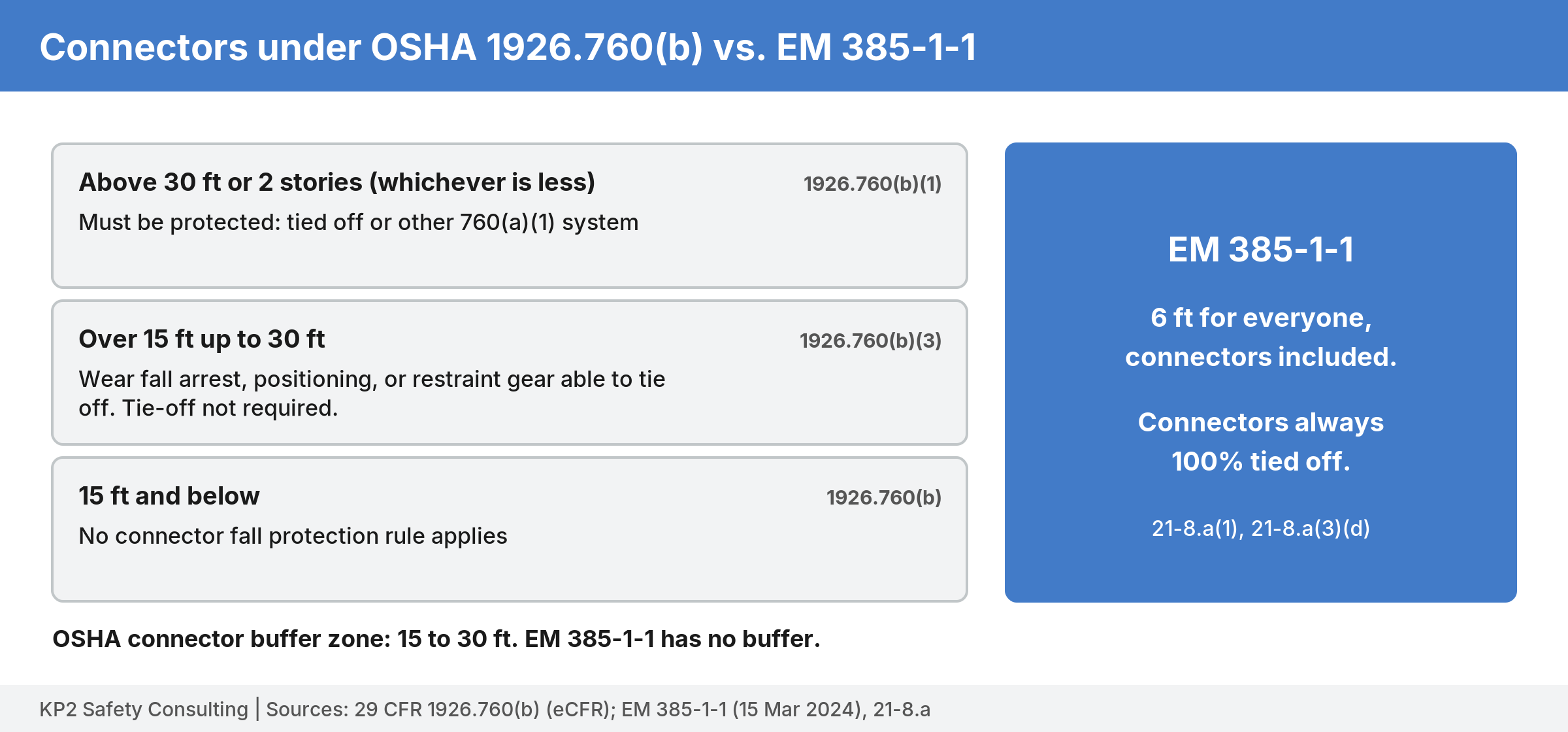
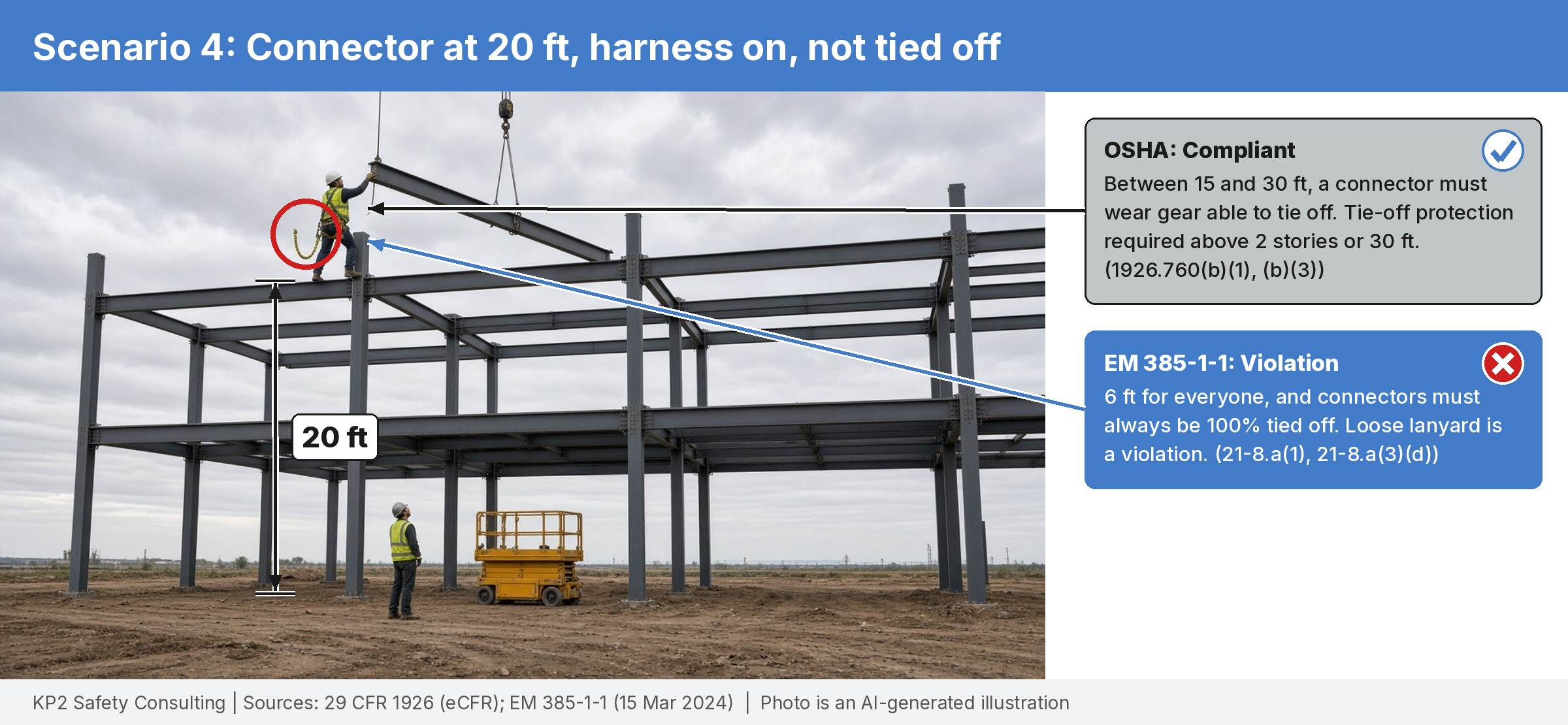
Figure 7 puts that on the steel: a connector at about 20 feet landing a beam from the crane, wearing a harness and lanyard but not tied off. That is compliant under OSHA and a violation under EM 385-1-1.
If your crews are used to the OSHA numbers, write the 6-foot rule into your AHAs for federal work. The KP2 AHA Library has fall protection, scaffold, and steel erection AHAs written to both standards.
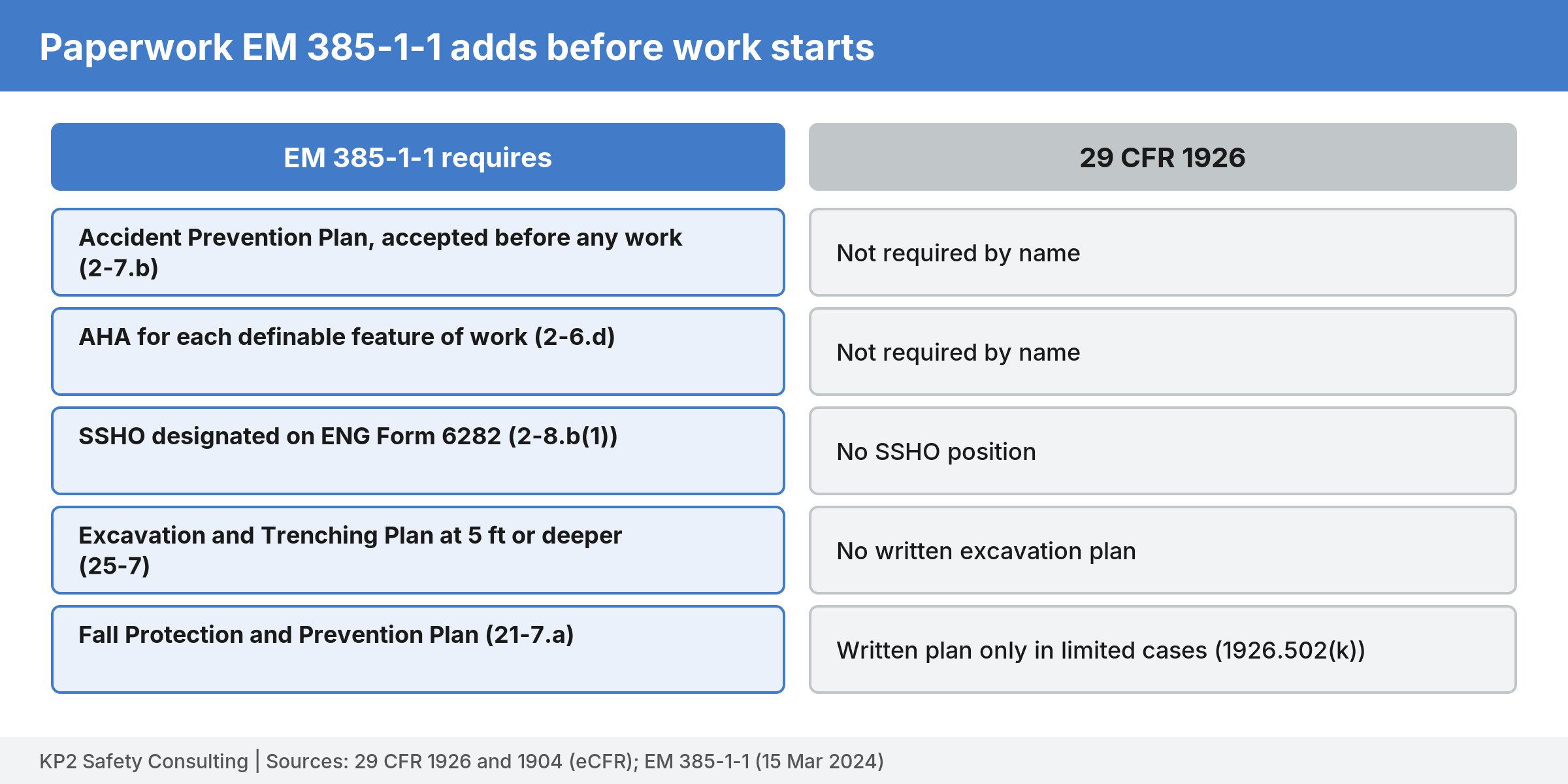
Most of the extra work on a federal job is on paper, and it has to be accepted before you start. As Figure 8 shows, EM 385-1-1 requires an Accident Prevention Plan accepted by the KO or COR before any work begins (2-7.b), an Activity Hazard Analysis for each definable feature of work (2-6.d), a Site Safety and Health Officer designated on the mandatory ENG Form 6282 (2-8.b(1)), an Excavation and Trenching Plan for excavations 5 feet or deeper (25-7), and a Fall Protection and Prevention Plan (21-7.a). Part 1926 does not require an APP, an AHA, or an SSHO by name, and it only calls for a written fall protection plan in limited cases such as leading edge, precast, and residential work (1926.502(k)).
If the AHA is new to you, start with AHA vs JHA and how to assign a RAC, then grab a free sample AHA to see the format.
People on Site: SSHOs and First Aid
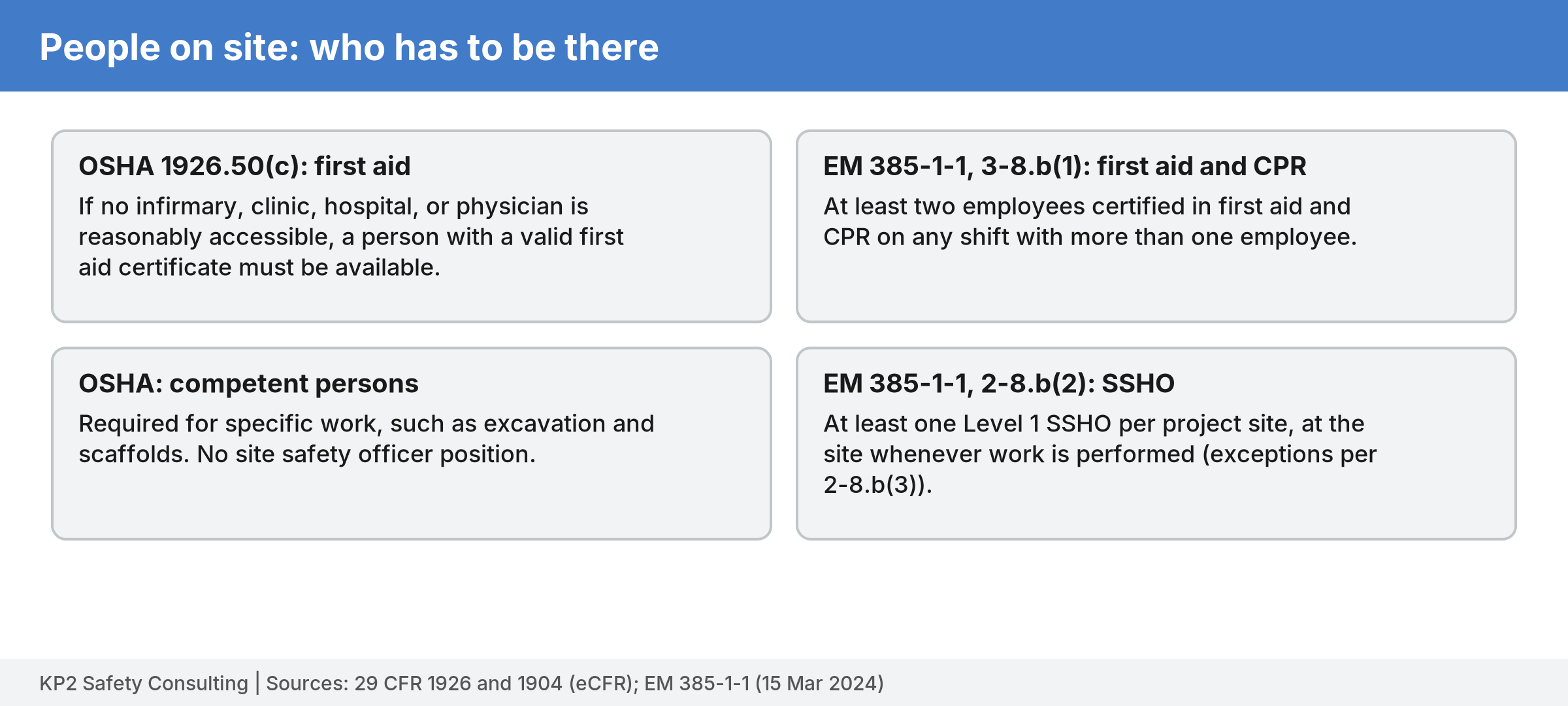
OSHA relies on competent persons for specific work, like excavations and scaffolds, but it has no site safety officer position. EM 385-1-1 requires at least one Level 1 SSHO at each project site, at the site of work whenever work is performed (2-8.b(2)). The KO and the local SOHO can modify that in the contract for some lower-risk work (2-8.b(3)), but a Level 1 SSHO is required on any project with a residual RAC of high or extremely high (2-8.b(2)(f)).
First aid is the other surprise. OSHA requires a person with a valid first aid certificate at the worksite when there is no infirmary, clinic, hospital, or physician reasonably accessible (1926.50(c)). EM 385-1-1 requires at least two employees certified in first aid and CPR on any shift with more than one employee (3-8.b(1)). Need to get your crew certified? I offer in-person American Red Cross First Aid, CPR and AED training as an American Red Cross instructor. Figure 9 lays out both.
The Reporting Clock After an Accident
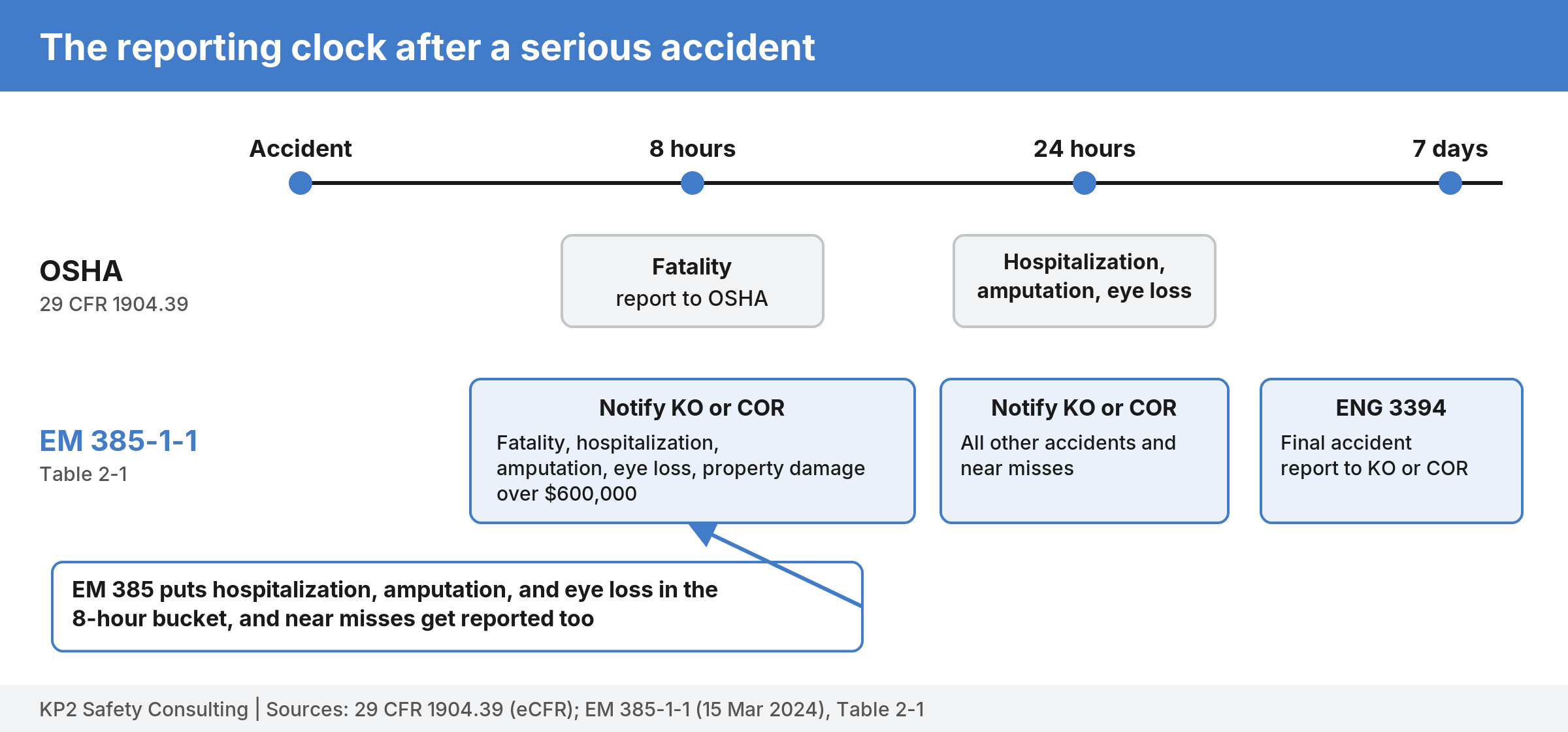
Under OSHA, you report a fatality within 8 hours, and an in-patient hospitalization, amputation, or loss of an eye within 24 hours (29 CFR 1904.39). EM 385-1-1 Table 2-1 works on a faster clock to the government: notify the KO or COR immediately, no later than 8 hours, for a fatality, in-patient hospitalization, amputation, eye loss, or property damage over $600,000. All other accidents and near misses go to the KO or COR immediately, no later than 24 hours, and the final report on ENG 3394 is due within 7 days. Figure 10 lines the two clocks up. Note the callout: hospitalizations land in the 8-hour bucket under EM 385, and near misses get reported too.
Safety Meetings Have a Schedule
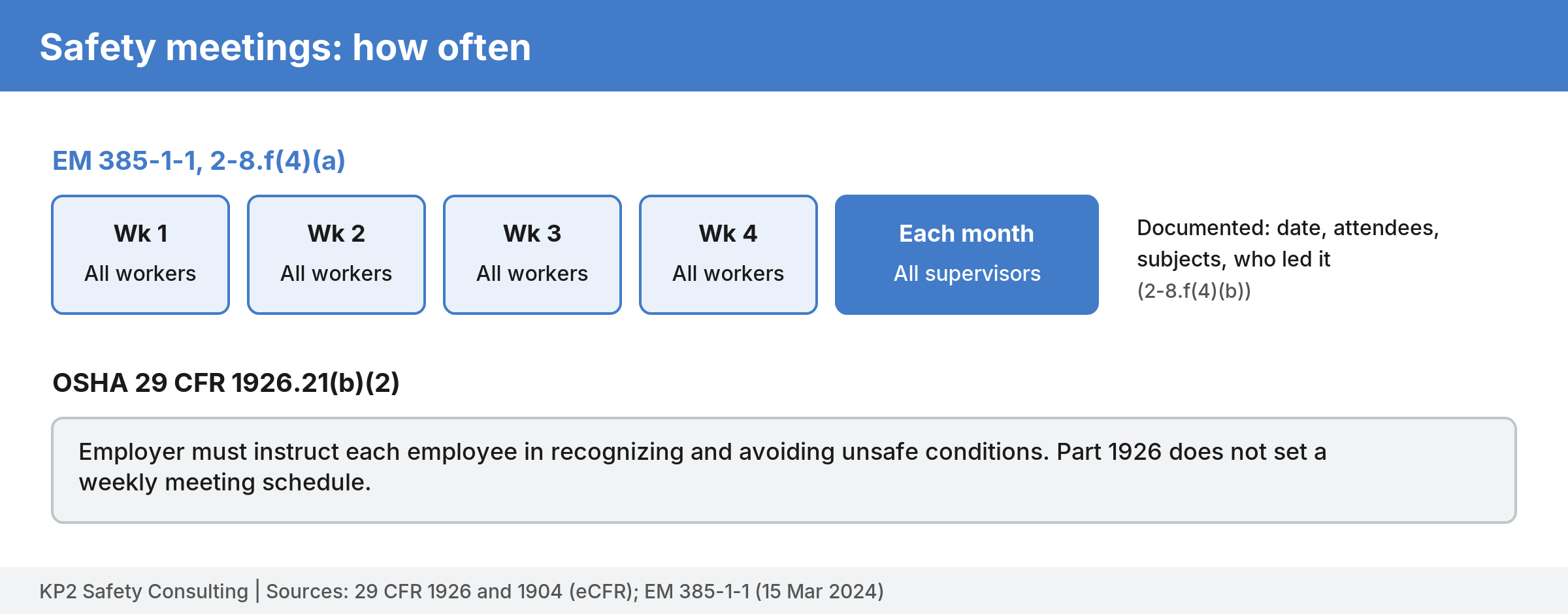
OSHA requires you to instruct each employee in recognizing and avoiding unsafe conditions (1926.21(b)(2)), but Part 1926 does not set a weekly meeting schedule. EM 385-1-1 does. Safety meetings must be held at least once a month for all supervisors and at least once a week for all workers, and each one has to be documented with the date, attendees, subjects, and who led it (2-8.f(4)). Figure 11 shows what that looks like over a month. I cover how to run them in toolbox talks under EM 385-1-1.
Where OSHA and EM 385-1-1 Match
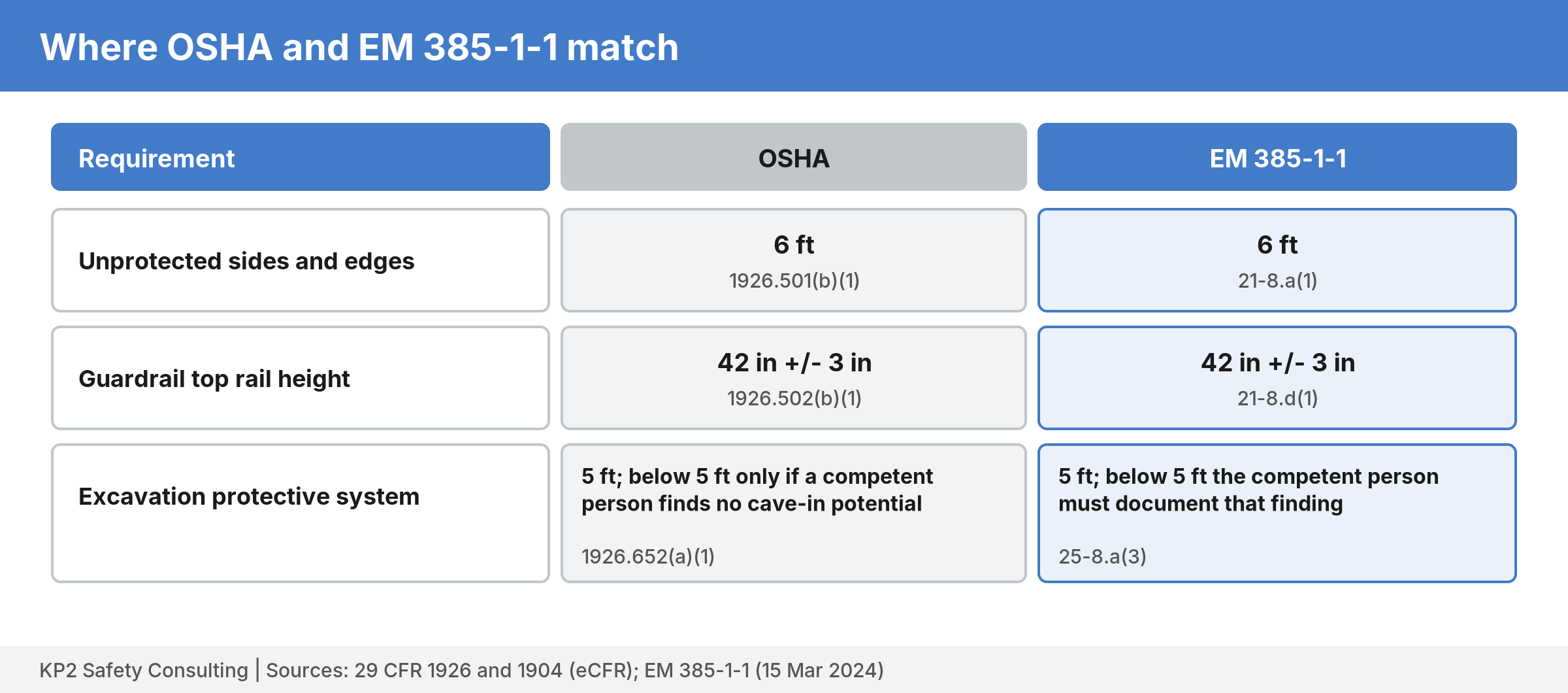
Not everything is different, and it helps to know where you can relax. Figure 12 shows three common ones. The 6-foot trigger for unprotected sides and edges is the same in both (1926.501(b)(1); 21-8.a(1)). Guardrail top rails are 42 inches, plus or minus 3 inches, in both (1926.502(b)(1); 21-8.d(1)). And both require a protective system in excavations 5 feet or deeper, with an exception below 5 feet when a competent person finds no potential for cave-in (OSHA also exempts excavations made entirely in stable rock) (1926.652(a)(1); 25-8.a(3)). EM 385-1-1 adds that the competent person has to document that call, and you still need a fixed means of egress.
How KP2 Can Help Before You Mobilize
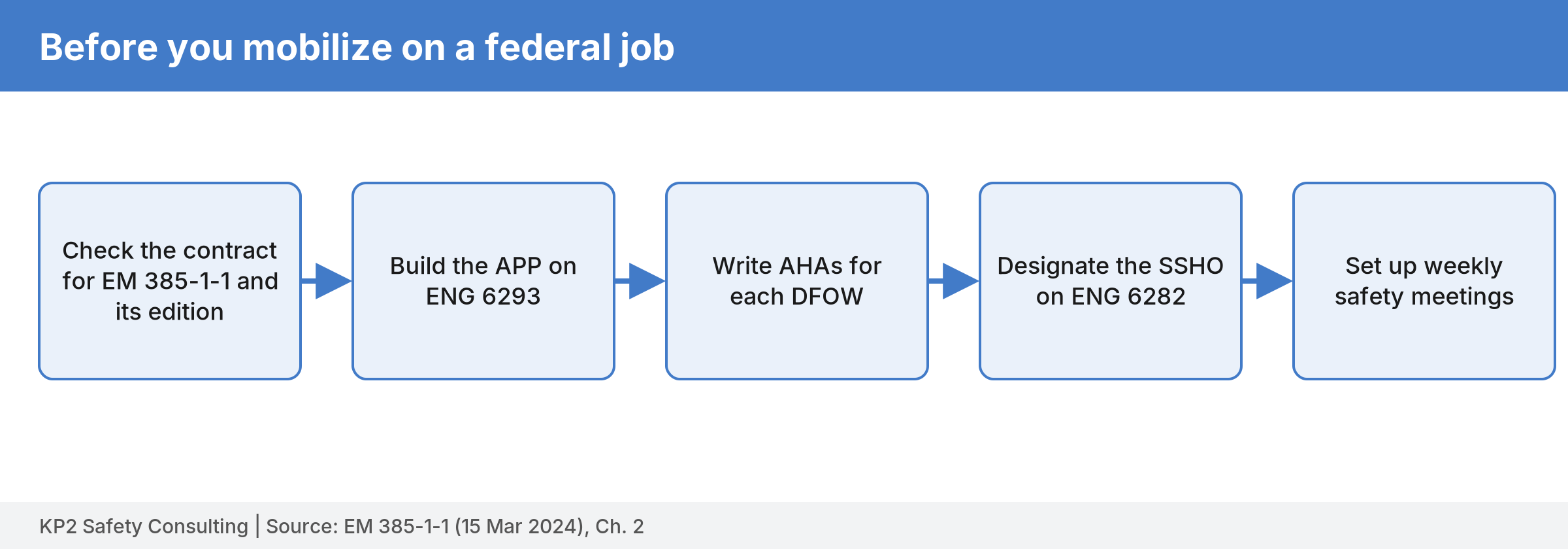
If this is your first USACE or federal job, Figure 13 is the order I would work in: confirm EM 385-1-1 and its edition in the contract, build the Accident Prevention Plan, write AHAs for each definable feature of work, designate the SSHO, and set up the weekly meetings. The KP2 AHA Library has AHAs written to both OSHA and EM 385-1-1, the 52-week toolbox talk pack cites both on every talk, and my fractional safety service puts an experienced safety professional on your project without a full-time hire.
Questions about a specific contract? Email me at [email protected] or call the office at 410-216-4424.