
AHA vs JHA: What's the Difference and Which One Does a Federal Job Need?
A sub calls me on a Tuesday afternoon. They just won their first Corps of Engineers job, they have a binder of job hazard analyses from ten years of commercial work, and the preconstruction meeting is Friday. Their question is simple: can we just change the header to say AHA and send these in? I love that question, because the honest answer saves them a lot of grief later.
The answer is maybe, and it depends on what is on the page, not what the document is called. In this article I will show you, with a picture for each piece, how an AHA and a JHA compare, what OSHA and EM 385-1-1 each require, when a JHA will pass on a federal job, and where the two rule books set different numbers.
The Short Answer
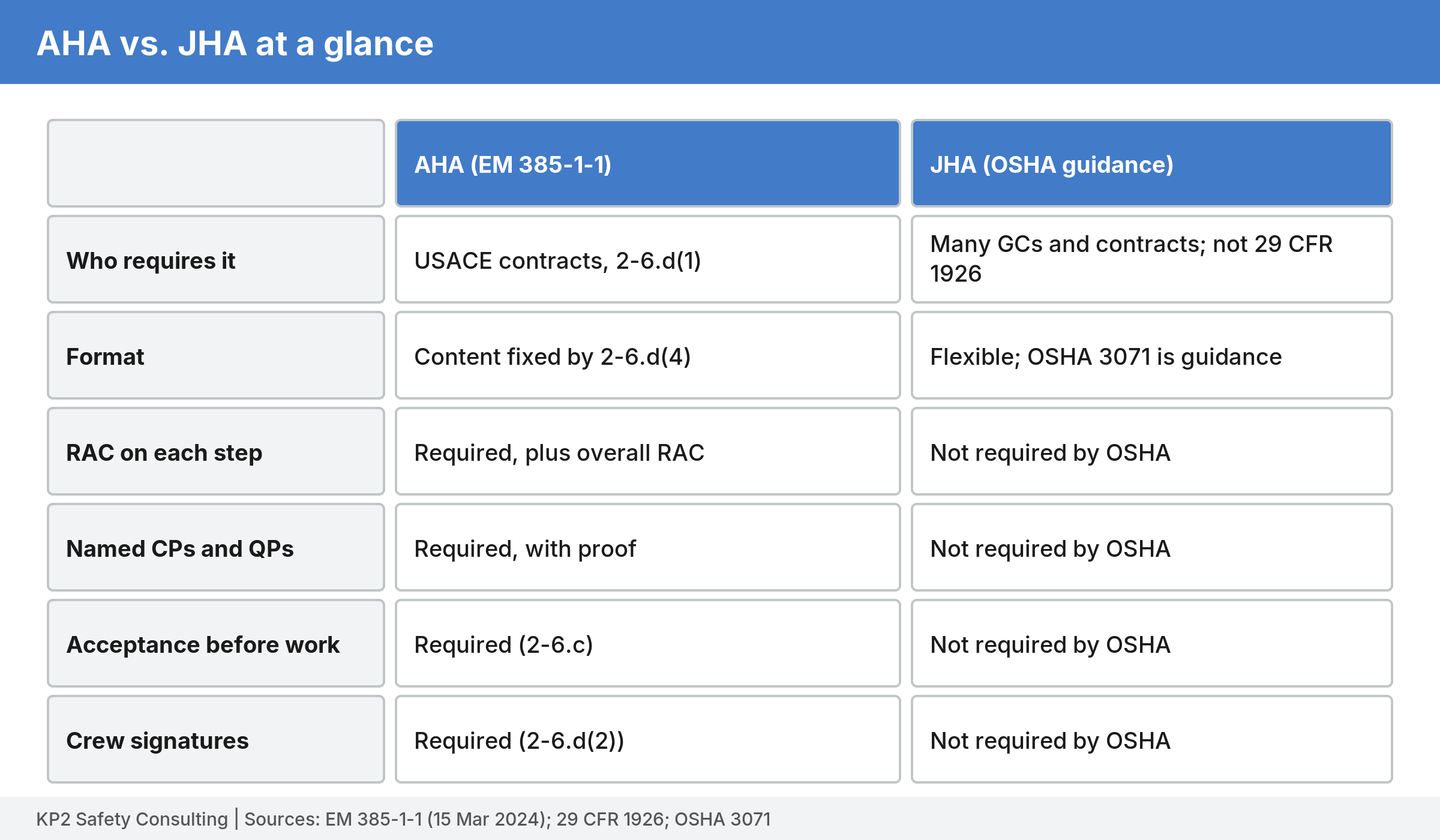
An activity hazard analysis (AHA) and a job hazard analysis (JHA) are the same basic idea. Both break a piece of work into steps, list the hazards in each step, and list the controls. The difference is who requires them and how much detail they demand. The AHA is the term EM 385-1-1 uses, and the manual spells out exactly what it must contain. The JHA is a general industry and construction practice that OSHA describes in its guidance, but OSHA's construction standards do not prescribe a JHA format. Figure 1 puts the two side by side.
What a JHA Is
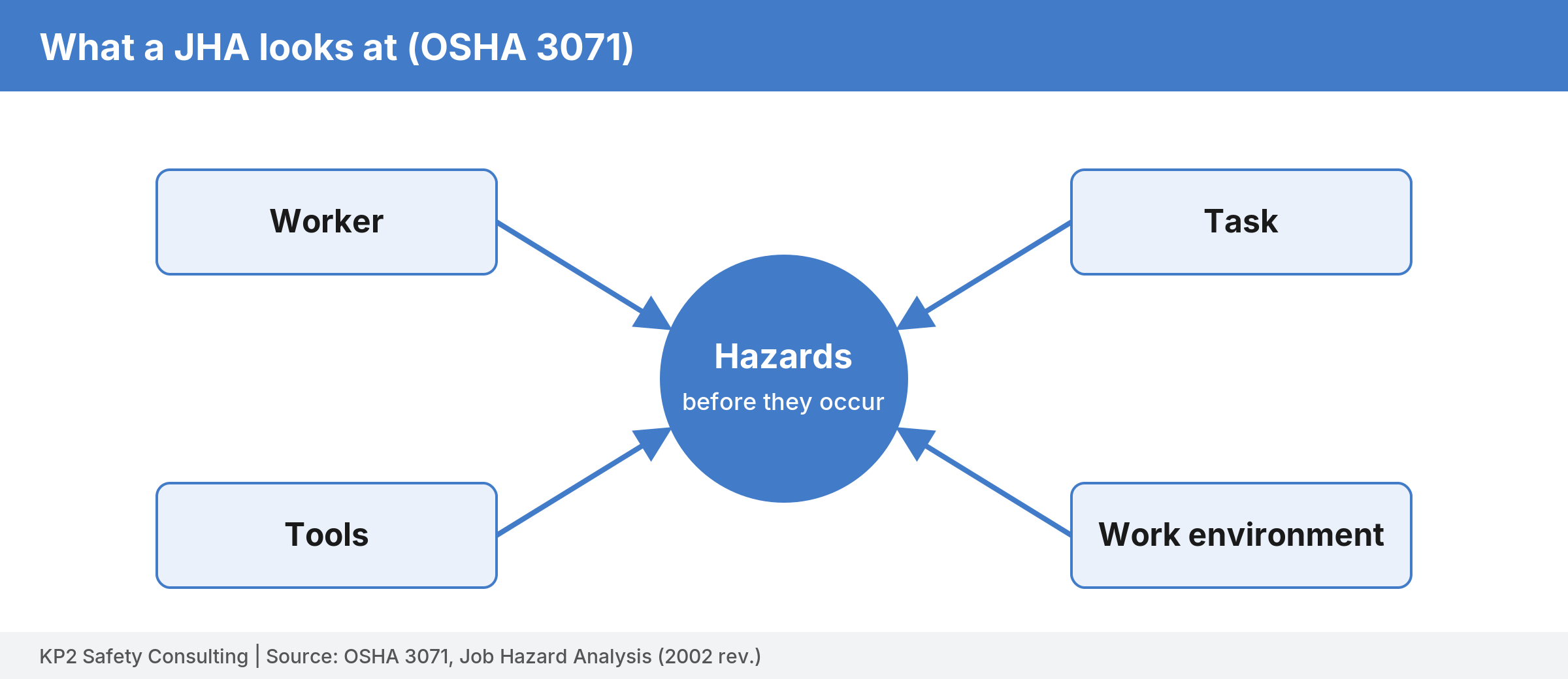
OSHA's own booklet, Job Hazard Analysis (OSHA 3071), describes a JHA as a technique that focuses on job tasks as a way to identify hazards before they occur, looking at the relationship between the worker, the task, the tools, and the work environment. It is a guidance document, not a regulation. Figure 2 shows those four pieces around the hazards you are trying to catch.
On the regulatory side, 29 CFR 1926 does not use the term JHA or AHA. What it does require is that the employer initiate and maintain the programs necessary to comply with Part 1926 (1926.20(b)(1)), provide for frequent and regular inspections by competent persons (1926.20(b)(2)), and instruct each employee in recognizing and avoiding unsafe conditions (1926.21(b)(2)). A good JHA is one of the most practical ways to show you are doing those things, which is why so many general contractors require one on commercial work even though OSHA does not.
What an AHA Is
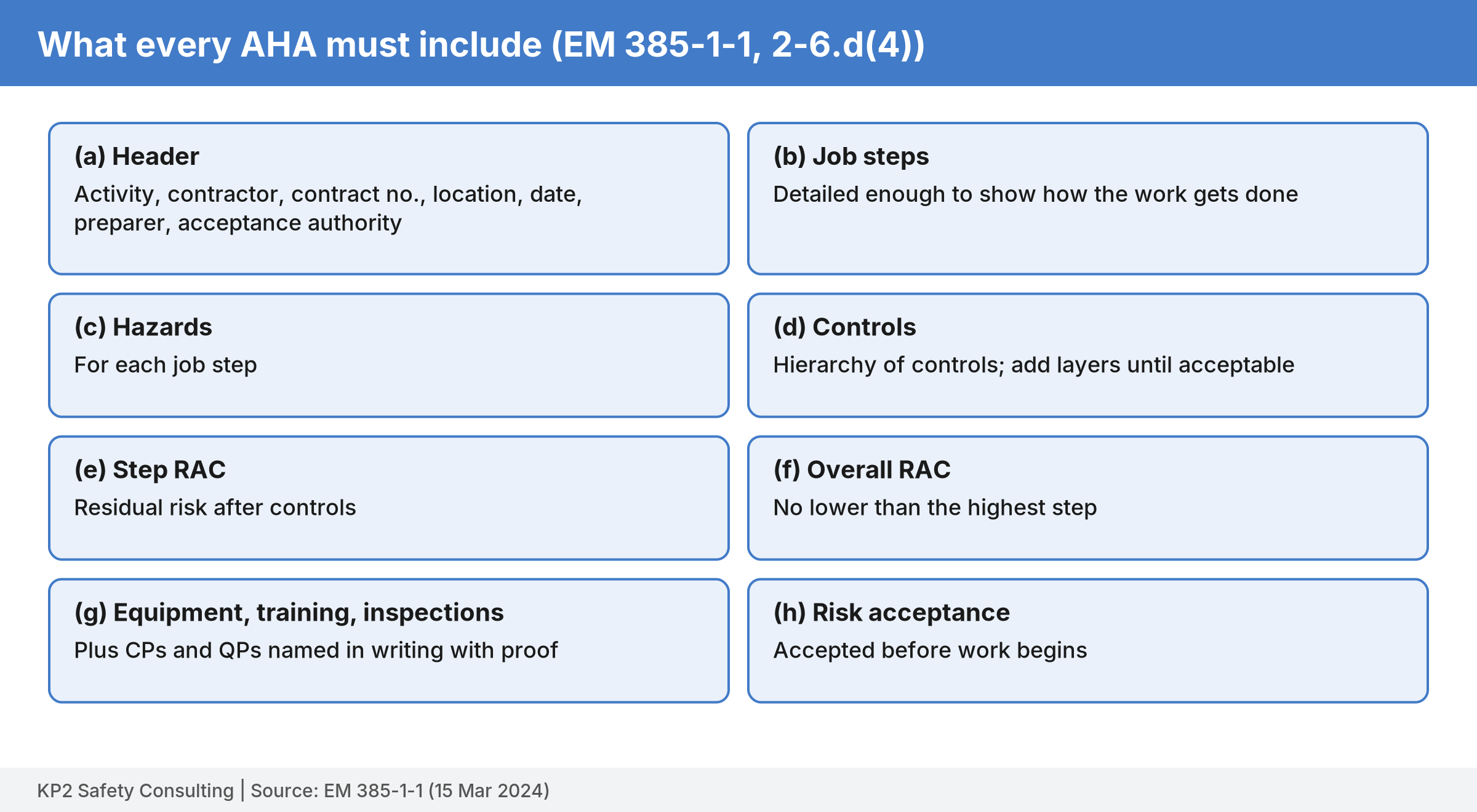
On USACE work, EM 385-1-1 makes the AHA mandatory. AHAs must be prepared and documented for all field, laboratory, industrial, and maintenance activities, and an initial AHA must be prepared before beginning each work activity, task, or definable feature of work (2-6.d(1)). The manual then lists what every AHA must include in 2-6.d(4):
- The activity name, contractor name and contract number, project location, date, preparer's name and title, and the acceptance authority's name and title.
- Job steps detailed enough that a reader understands how the work will be done, including things like equipment, voltages, chemical quantities, and heights or depths.
- The hazards for each step, and the controls for each hazard, following the hierarchy of controls.
- A Risk Assessment Code for each step based on residual risk, and an overall RAC no lower than the highest step.
- Equipment, training, and inspection requirements, plus competent and qualified persons designated by name in writing, with proof of their qualifications.
- Risk acceptance before work begins.
Figure 3 lays the same list out as eight boxes you can check against your own document.
The AHA has to be developed by competent persons (2-4.c(1)), reviewed and signed by every involved employee before starting the task (2-6.d(2)), and kept with the crew while the work is happening (2-6.d(3)). For the full walkthrough, see my article on how to write an AHA, and if you are using the Corps form, read what changed on ENG Form 6206 in 2024.
Can a JHA Substitute for an AHA?
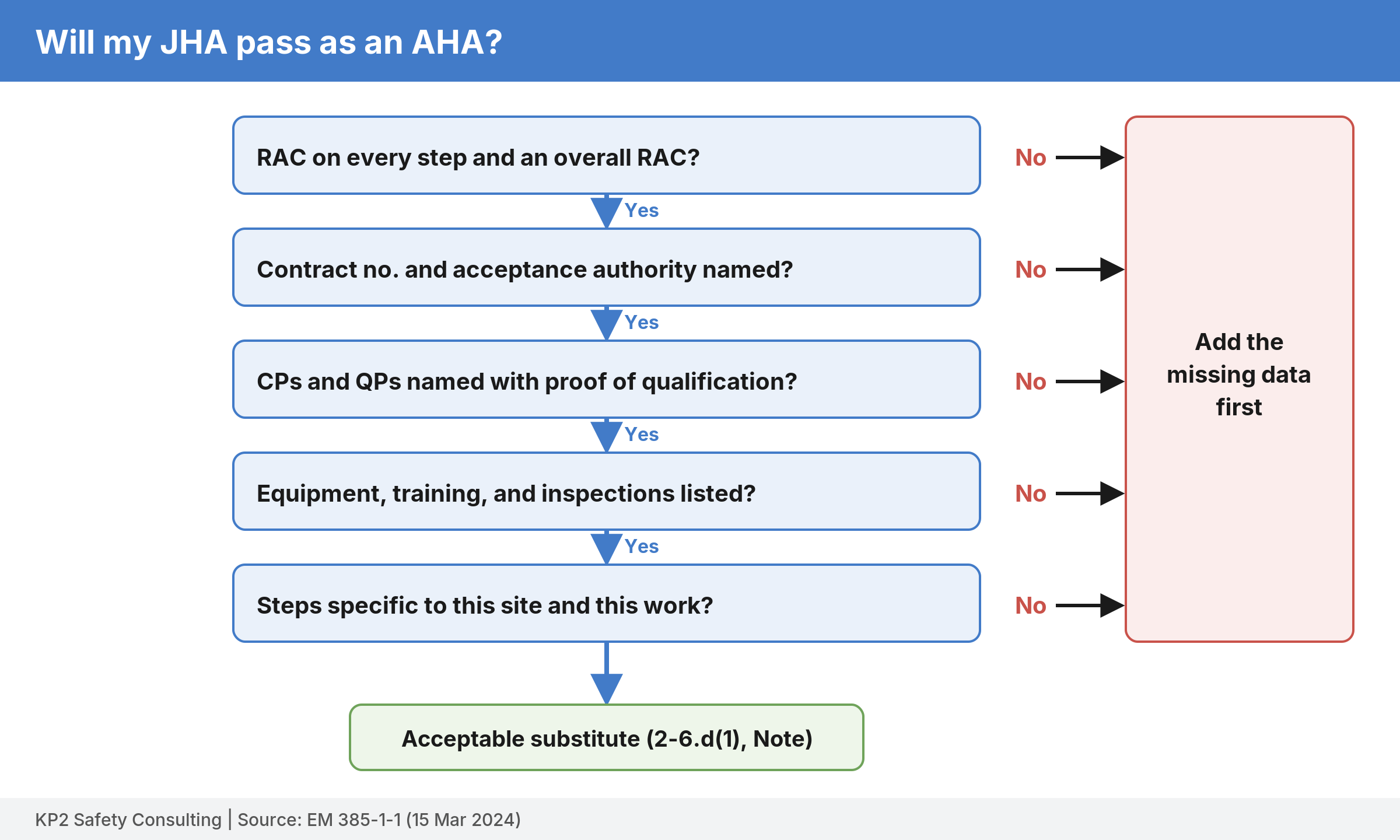
Yes, with one important condition. EM 385-1-1 says JSAs, JHAs, or similar risk management tools are considered equivalent to, and acceptable substitutes for, AHAs as long as the data collected is the same as that required by the AHA (note to 2-6.d(1)).
That condition is where most commercial JHAs fall short. In my experience, the typical JHA a sub brings over from private work is missing several of these:
- A RAC on every step and an overall RAC.
- The contract number and the acceptance authority's name and title.
- Competent persons named individually, with proof of competency attached.
- Equipment, training, and inspection requirements for the activity.
- Steps written specifically enough for this site, rather than generic steps that fit any job.
If your JHA has all of the 2-6.d(4) content, call it whatever you like. If it does not, the KO or COR is going to send it back, and the time you saved by reusing it disappears. Figure 4 turns that into a quick yes or no test.
Where OSHA and EM 385-1-1 Ask for Different Things
Because the AHA has to reflect the right standard, the controls on a federal job sometimes need to be stricter than the ones in your commercial JHA. The manual says that where requirements vary, the most stringent requirements govern (Preamble, 5.a). A few places I see this come up:
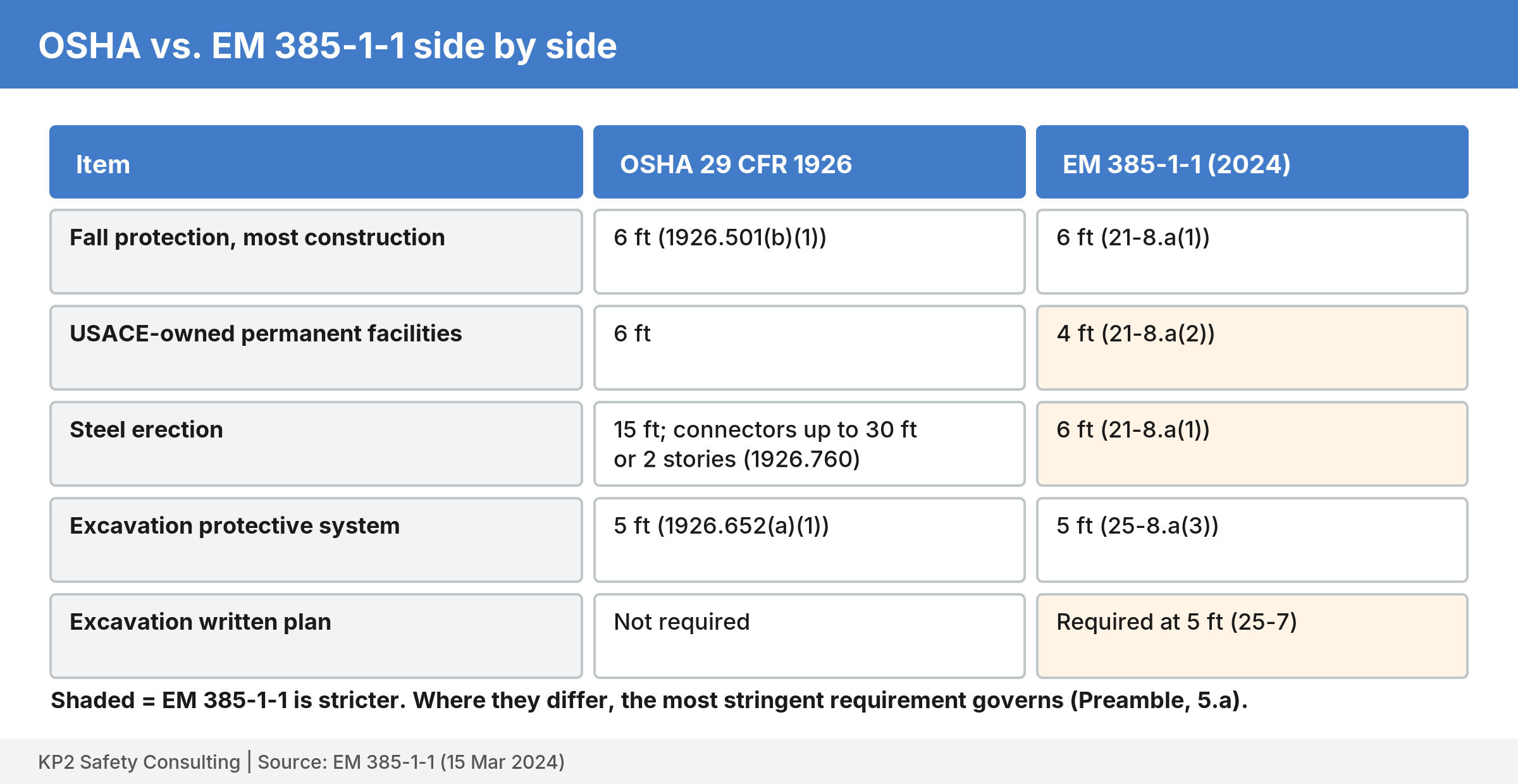
- Fall protection on Corps work. EM 385-1-1 uses a 6 foot threshold for all covered work, including steel erection (21-8.a(1)), and 4 feet on USACE-owned or operated permanent facilities near open-sided floors, platforms, or unprotected edges (21-8.a(2)). OSHA uses 6 feet for most construction (1926.501(b)(1)) and 15 feet for most steel erection, with connectors allowed up to two stories or 30 feet, whichever is less, under specific conditions (1926.760). A steel erection AHA written to OSHA thresholds will not pass on a Corps job.
- Excavations. Both require a protective system at 5 feet unless the excavation is in stable rock or a competent person finds no indication of a potential cave-in in a shallower cut (1926.652(a)(1); EM 385-1-1, 25-8.a(3)). EM 385-1-1 adds that the excavation AHA must be developed by a competent person and show egress locations and the CP's credentials (25-6), and that an Excavation and Trenching Plan is required at 5 feet or more (25-7).
- Paperwork in general. OSHA does not require a written hazard analysis for most construction activities. EM 385-1-1 requires the AHA, its acceptance before work, and signatures from every involved worker.
Figure 5 lines up the numbers side by side.
Which One Does Your Federal Job Need?
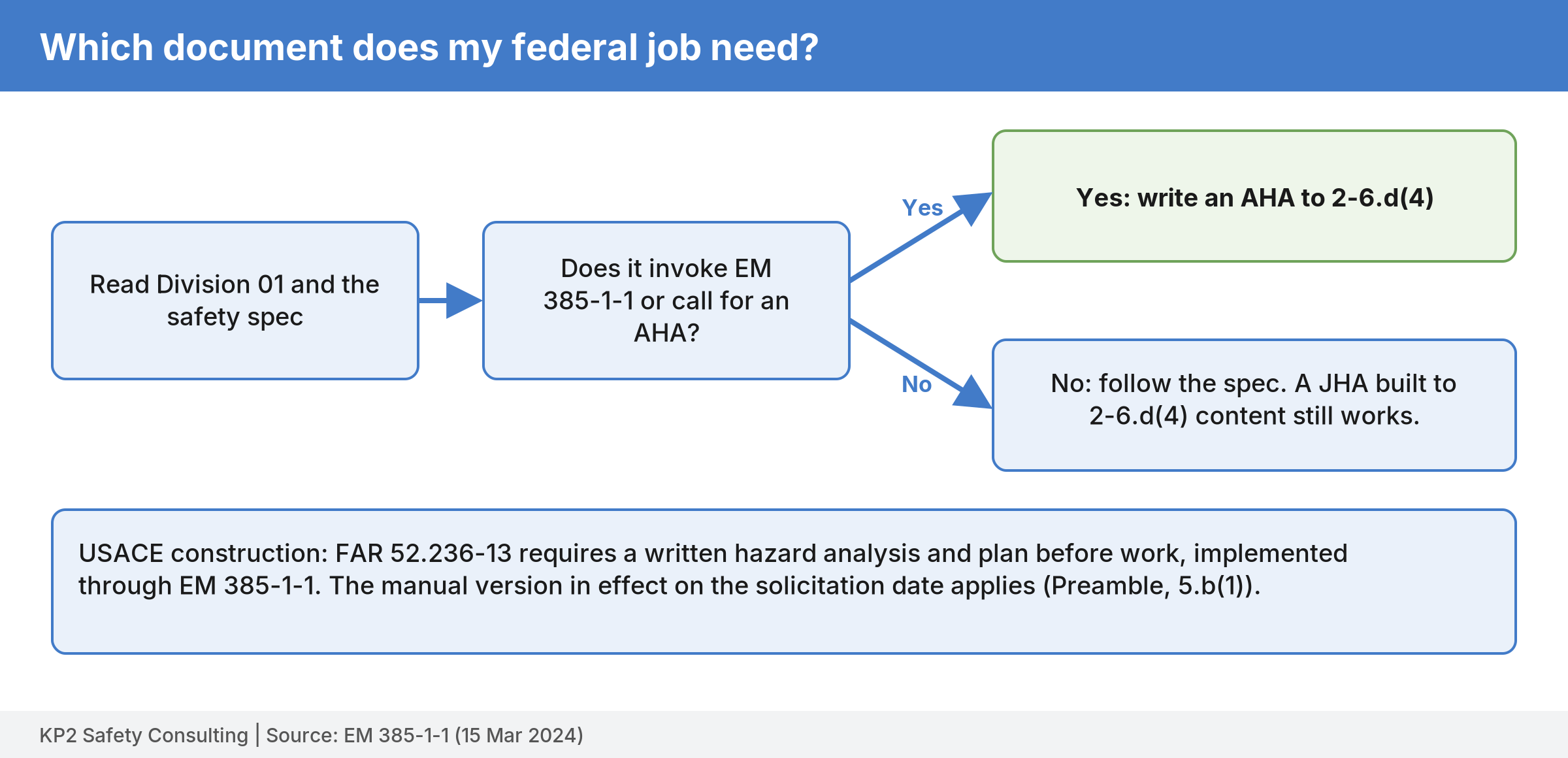
Start with the contract. On USACE construction, the Federal Acquisition Regulation accident prevention clause, FAR 52.236-13, requires a written plan analyzing the significant hazards and how you will control them before you start, and the Corps implements that through EM 385-1-1 and the Accident Prevention Plan. Contractors must comply with the version of the manual in effect on the date of solicitation, and existing contracts keep the edition they started with (Preamble, 5.b(1)). Many other federal owners write EM 385-1-1 or their own AHA requirement into the specifications, so read Division 01 carefully. If the specs call for an AHA, give them an AHA. If they call for a JHA but reference EM 385-1-1, write it to the 2-6.d(4) content anyway and you will never be wrong. Figure 6 shows the order I work through it.
FAQ
Is a JHA the same as an AHA?
They cover the same ground, but an AHA under EM 385-1-1 has specific required content, including RACs, named competent persons, and risk acceptance. A JHA is acceptable only if it collects the same data.
Does OSHA require a JHA?
OSHA's construction standards do not require a document called a JHA. OSHA publishes JHA guidance in OSHA 3071, and many contracts and GCs require one.
Can I use the same document for a private job and a Corps job?
You can use the same format if it meets 2-6.d(4), but the controls must match the stricter standard on the federal job, such as fall protection thresholds.
What is a JSA?
A job safety analysis. EM 385-1-1 treats JSAs, JHAs, and similar tools as acceptable substitutes for AHAs when the data matches.
Get It Right the First Time
The KP2 AHA Library has more than 200 pre-built AHAs written to EM 385-1-1 or OSHA 1926 and customized with your project information, so you can submit something a federal reviewer already recognizes. Want to see the format first? Download the free sample AHA. If you need a safety professional on the job without a full-time hire, take a look at my fractional safety service. You can reach me at [email protected] or the office at 410-216-4424.