
Accident Prevention Plan (APP) Basics: What EM 385-1-1 Requires and Why KOs Kick APPs Back
The trailer is set, the equipment is staged, and the crew is ready to go. Then the email comes in from the Contracting Officer: APP not accepted, see comments. Nothing moves until it is fixed, and every day of waiting costs real money. I have watched good contractors lose weeks at the start of a job this way, and almost every time the reason was something fixable.
In this article I will walk you through what the 2024 EM 385-1-1 actually requires in an Accident Prevention Plan, where the old Appendix A went, how ENG Form 6293 fits in, and the reasons I see most often when a KO sends an APP back, with a graphic for each section.
A Note on "Appendix A"
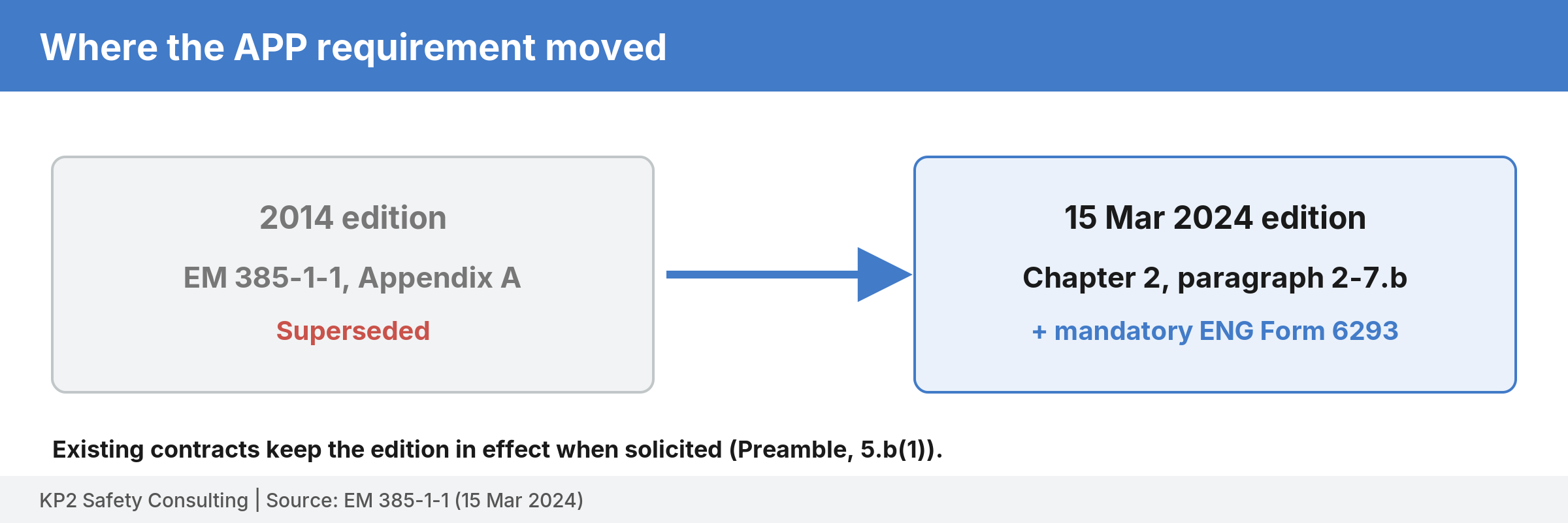
If you have been around Corps work for a while, you probably remember the APP as "Appendix A" of EM 385-1-1. That was the 2014 edition. The 15 March 2024 edition superseded it, and the APP requirements now live in Chapter 2, paragraph 2-7.b, with a mandatory worksheet, ENG Form 6293, Accident Prevention Plan (APP) Worksheet (2-7.b(1); 2-10.d). If your template still says "Appendix A" or cites 2014 paragraph numbers, that alone can draw a comment. Check your contract, though, because existing contracts keep using the edition that was in effect when they were solicited (Preamble, 5.b(1)). Figure 1 shows the move.
What an APP Is and Where the Requirement Comes From
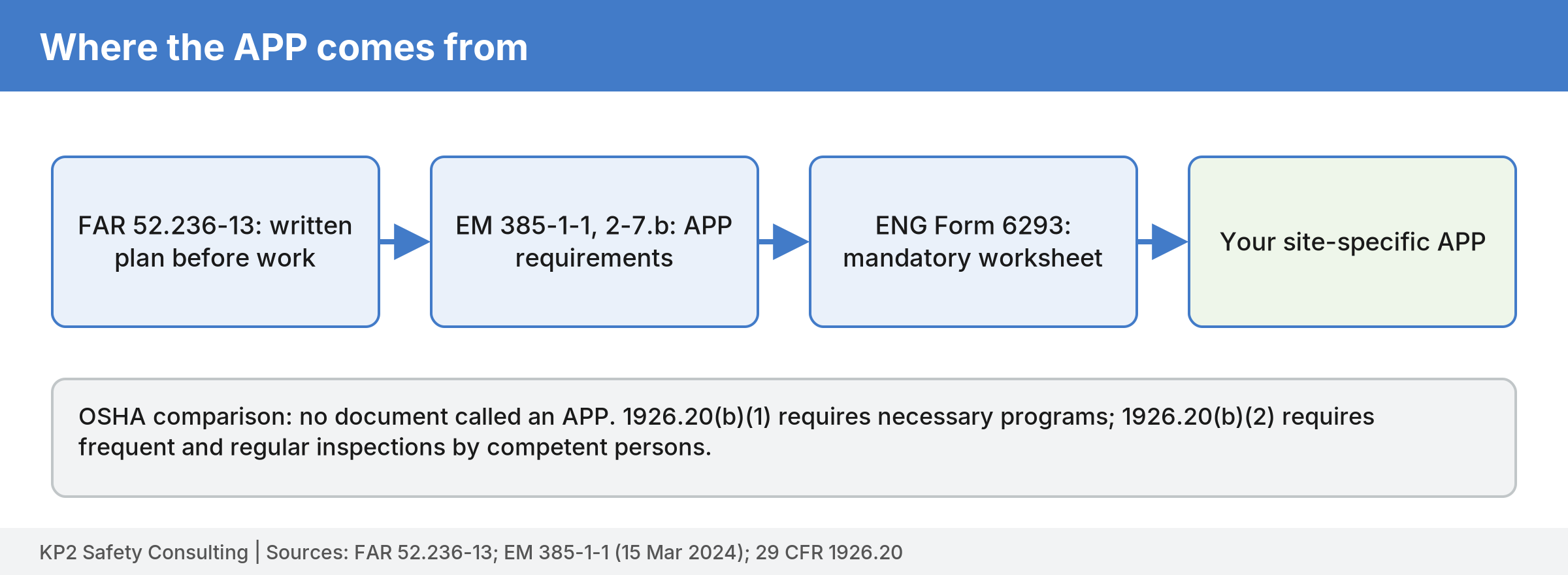
The requirement starts with the Federal Acquisition Regulation. The accident prevention clause, FAR 52.236-13, requires the contractor, before commencing work, to submit a written plan that analyzes the significant hazards of the contract work and how they will be controlled. EM 385-1-1 is how the Corps puts that into practice.
The manual defines the APP as a written site-specific safety and occupational health plan that documents project, contract, and job-specific potential hazards, and the company policies, controls, and work practices that will be used to minimize them (2-7.b). For comparison, OSHA does not require a document called an APP. Under 29 CFR 1926.20(b)(1), the employer must initiate and maintain the programs necessary to comply with Part 1926, and under 1926.20(b)(2) those programs must provide for frequent and regular inspections by competent persons. The APP is the Corps' much more specific version of that idea. Figure 2 traces that chain from the FAR down to your plan.
What EM 385-1-1 Requires in an APP
Here is what paragraph 2-7.b and the surrounding paragraphs require:
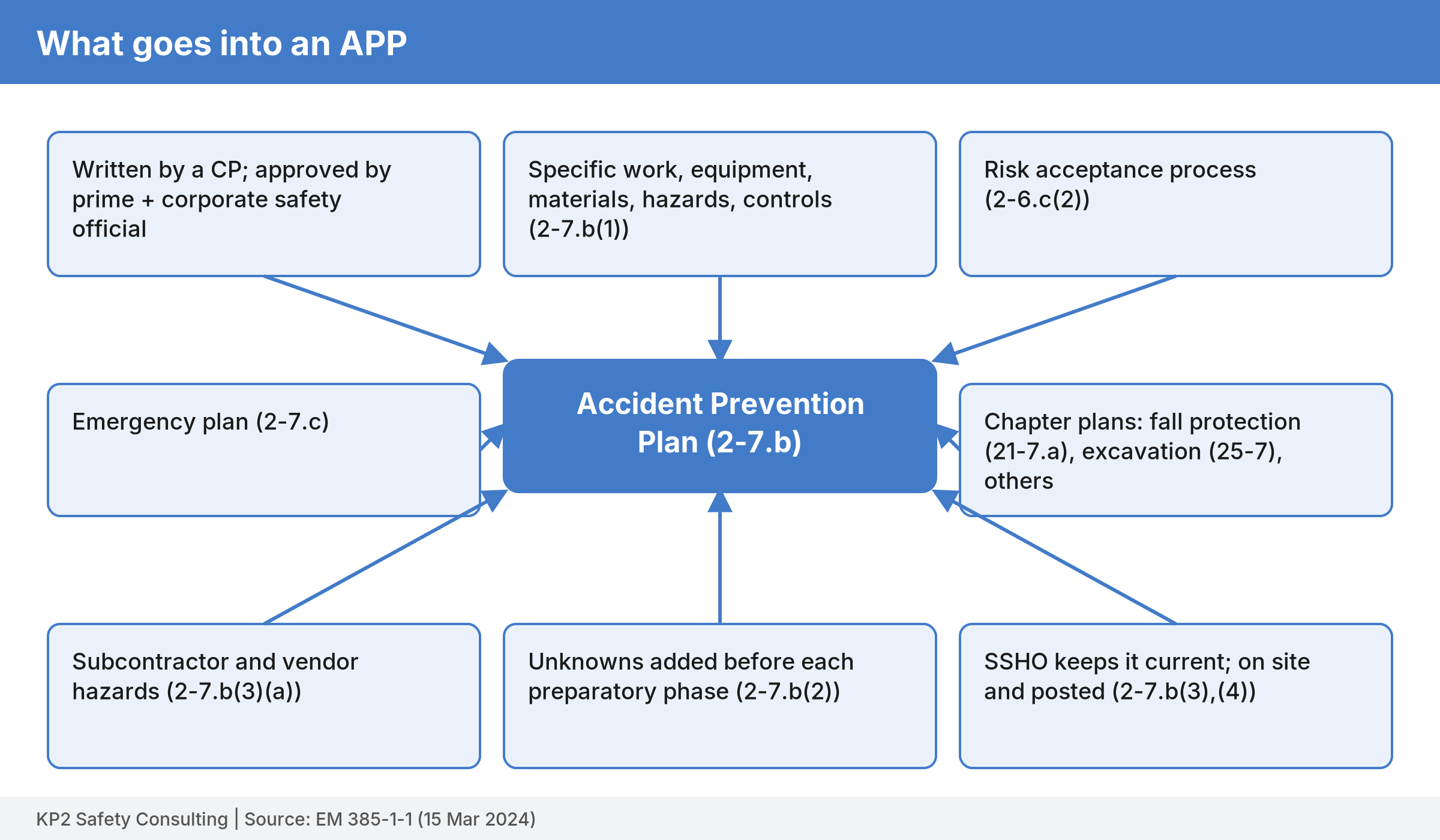
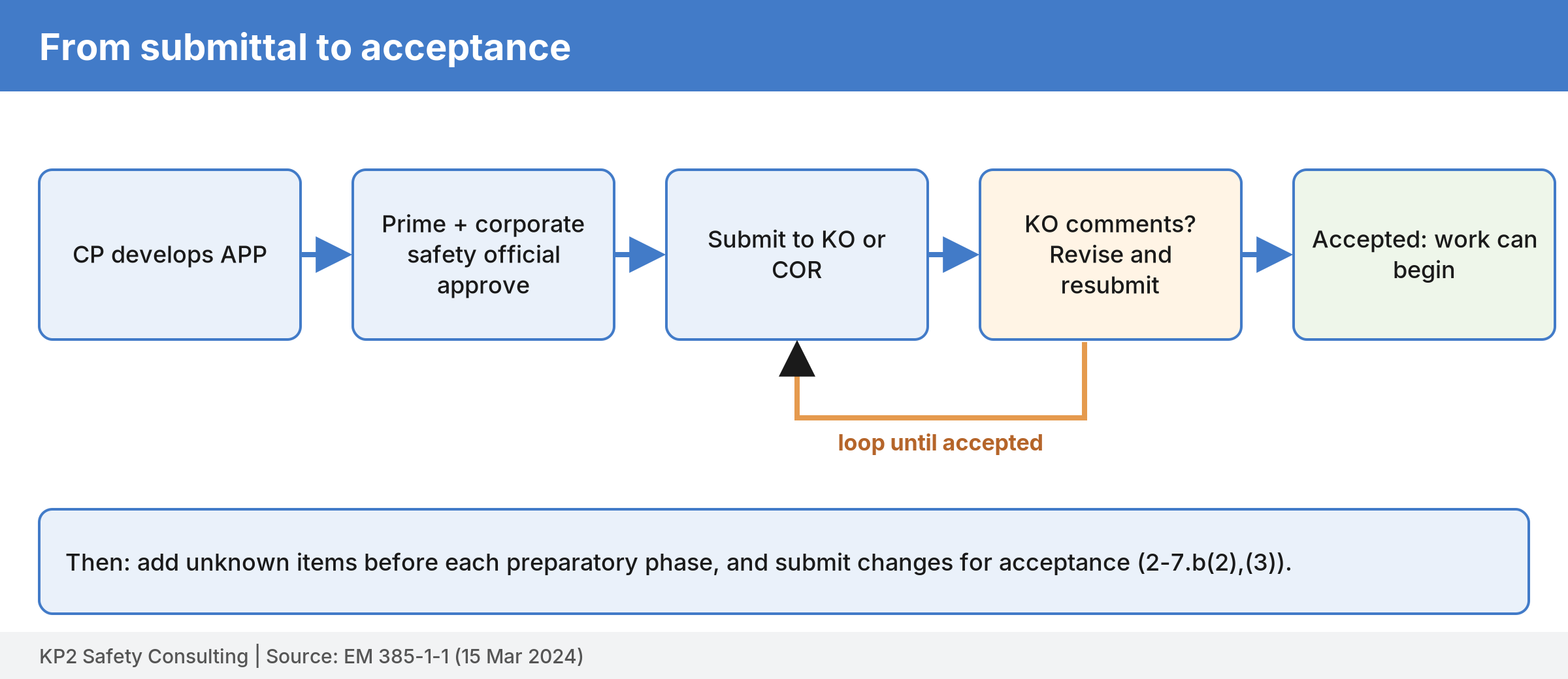
- Who writes and approves it. The APP must be developed by a competent person and reviewed and approved by the prime contractor and the corporate safety official, then submitted to the KO or COR for review and acceptance before any work begins. No contract work can begin without a KO or COR accepted APP (2-7.b). The prime contractor must keep the CP's credentials on site (2-4.g(3)), and the corporate safety official signs and dates the approval (2-4.f(2)).
- What it covers. It must be written in English and describe the specific work, work processes, equipment, materials, hazards, and control measures, and it must follow ENG Form 6293 (2-7.b(1)).
- Unknowns. Portions of the work that are not known yet, such as subcontractors, fall protection type, or specific cranes, must be added and submitted before each preparatory phase meeting along with the appropriate AHAs (2-7.b(2)).
- Living document. The SSHO must keep evaluating and updating the APP throughout the project, and changes go back to the KO or COR for acceptance. It must address hazards from vendors and subcontractors and any unusual aspects of the project (2-7.b(3)).
- Availability. The accepted APP must be on site and accessible to all employees, with a copy on the safety bulletin board or a notice saying where it is (2-7.b(4)).
- Plans as part of the APP. All plans and other safety submittals go in as part of the APP to the KO or COR, and work cannot begin until they are accepted (2-7.a(2) and (3)). That includes the written emergency plan (2-7.c) and the chapter-specific plans, such as the Fall Protection and Prevention Plan (21-7.a) and the Excavation and Trenching Plan required at 5 feet or more (25-7).
- Risk acceptance. The prime contractor's process for who accepts each level of residual risk must be included in the APP (2-6.c(2)).
Figure 3 puts all of those pieces around the plan.
What ENG Form 6293 asks for
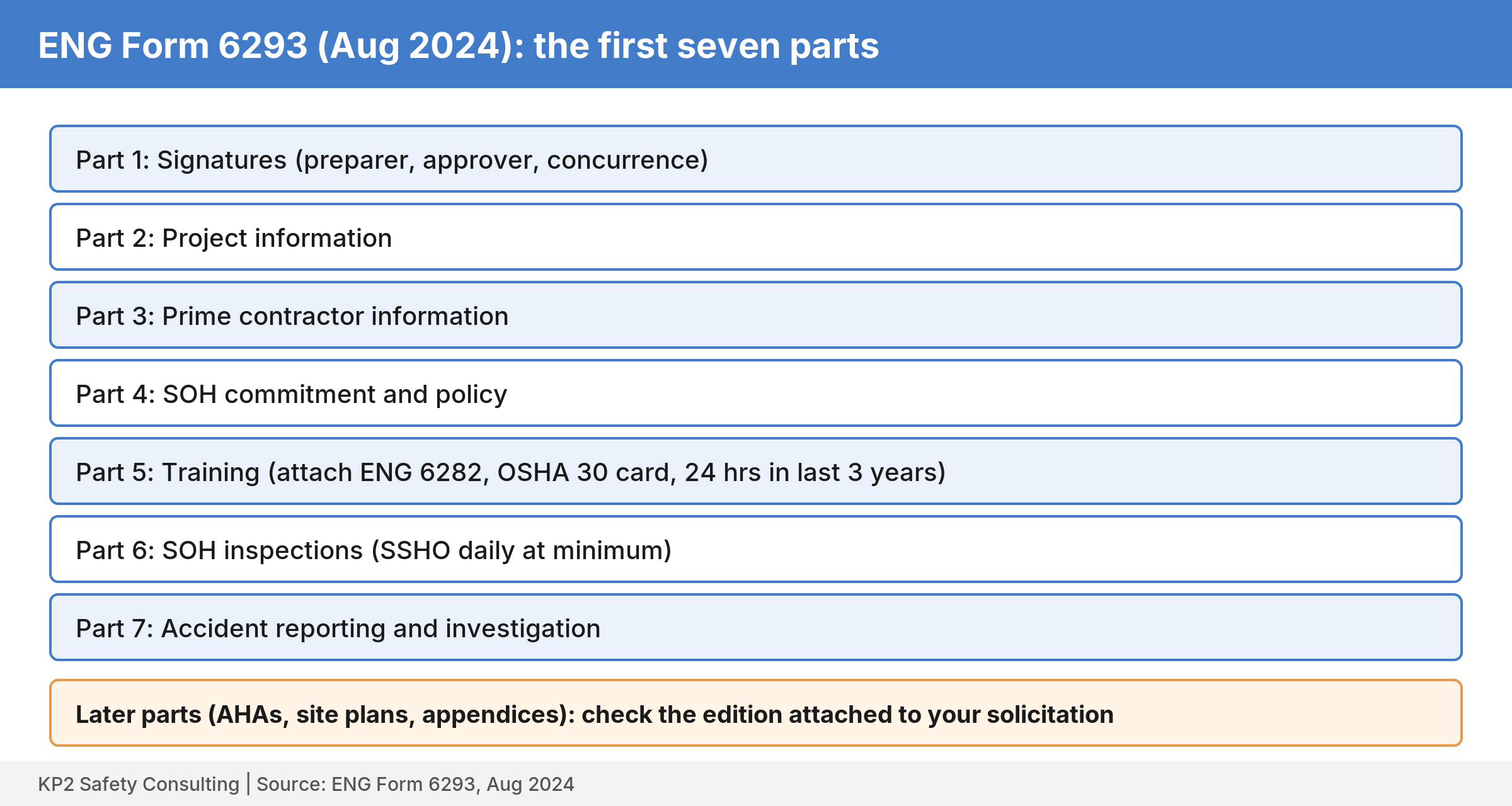
The August 2024 edition of ENG Form 6293 is organized in parts that walk through signatures, project and prime contractor information, safety commitment and policy, training, inspections, accident reporting, and the AHAs and site-specific plans, with appendices for items like the subcontractor list and personnel qualifications. The training part asks you to attach, for designated SSHOs, the ENG Form 6282 designation letter, the OSHA 30-hour card, and proof of 24 hours of safety training within the last three years. I always pull the edition attached to the solicitation, because that is the one the KO will review against. Figure 4 lists the parts I confirmed.
The Most Common Reasons KOs Kick an APP Back
This list comes from my own experience reviewing and rewriting APPs. Your KO may have different pet peeves, but these come up again and again. Figure 5 turns the list into a checklist you can run before you submit.
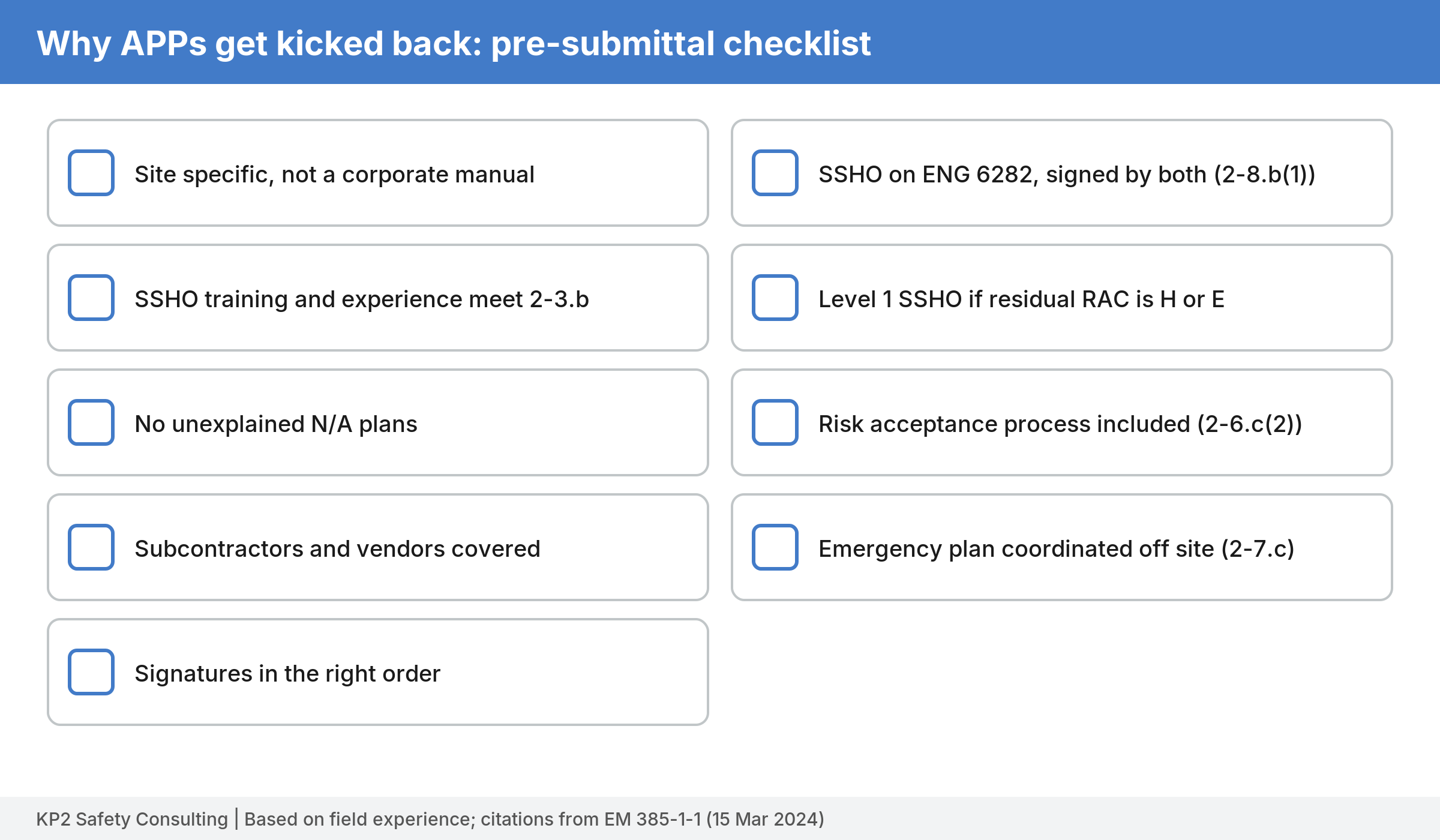
- It reads like a corporate safety manual. The APP has to be site specific and tied to this contract's work. If I can swap the project name and use it on another job, a reviewer can tell.
- Missing or weak SSHO documentation. The SSHO must be designated on the mandatory ENG Form 6282, signed by both the corporate safety official and the SSHO (2-8.b(1)), and must meet the training and experience requirements in 2-3.b. A Level 1 SSHO needs the OSHA 30-hour course, 24 hours of safety training in the past five years, and five years of safety experience within the last ten (or three years with a qualifying degree or certification). A common miss is assuming the OSHA 30 counts toward the 24 hours. The manual says it does not (2-3.b(1)(b), Note).
- The wrong SSHO level for the risk. Projects with a residual RAC of high or extremely high need a Level 1 SSHO on site, and a Level 2 or 3 cannot be assigned (2-8.b(2)(f)). See how to assign a RAC for why that matters.
- Plans marked "N/A" without explanation. If a required plan does not apply, say why. If it is not ready, say when it will be submitted.
- No risk acceptance process. Reviewers look for the 2-6.c(2) process naming who accepts each RAC level.
- Subcontractors left out. The APP has to cover how you will control hazards brought on by subs and vendors (2-7.b(3)(a)), and the subcontractor list has to be updated as they come on board.
- An emergency plan that is just phone numbers. The manual wants evacuation routes, rally points, accountability, coordination with off-site emergency services, and an offer of a site orientation to the responders (2-7.c). Responders notice when that coordination never happened.
- Signatures missing or out of order. The CP prepares it, the prime contractor and corporate safety official approve it, and only then does it go to the KO or COR.
How KP2 Can Help
I offer a $595 APP service built around a questionnaire. You answer the questions about your project, crews, and subcontractors, and I write a site-specific APP to the 2024 EM 385-1-1 and ENG Form 6293. If your KO sends it back, I revise it for free until it is accepted. Pair it with AHAs from the KP2 AHA Library, and if you need an experienced safety professional for the whole job without a full-time hire, look at my fractional safety service. Figure 6 shows how that plays out from submittal to acceptance.
FAQ
Where is Appendix A in the 2024 EM 385-1-1?
The 2024 edition moved the APP requirements into Chapter 2, paragraph 2-7.b, with the mandatory ENG Form 6293 worksheet. Appendix A was the 2014 edition.
Who has to write the APP?
A competent person develops it, and the prime contractor and corporate safety official review and approve it before it goes to the KO or COR (2-7.b).
Can work start before the APP is accepted?
No. No contract work can begin without a KO or COR accepted APP (2-7.b).
Do I resubmit the APP when things change?
Yes. Changes, revisions, and updates are approved by the contractor and submitted to the KO or COR for acceptance (2-7.b(3)).
Let's Get Your APP Accepted
To start an APP or ask about one that keeps coming back, email me at [email protected] or call the office at 410-216-4424. For more on the documents that go with it, read How to Write an AHA, AHA vs JHA, and what changed on ENG Form 6206 in 2024.