
ENG Form 6206 (2024 Edition): What's New in the USACE AHA Form
You finally have a clean set of AHAs for the job. Then the QA rep picks one up, flips to the bottom of the page, and asks why you are using an obsolete form. Nobody wants to rebuild twenty AHAs the week before mobilization, and the good news is you probably do not have to.
ENG Form 6206, the Corps of Engineers Activity Hazard Analysis form, was reissued with a September 2024 date. I laid the August 2023 and September 2024 editions side by side, and the changes are modest. In this article I will show you, with a graphic for each section, how to tell which edition you have, the four changes I confirmed, what stayed the same, and the two items I would still check on the official form before relying on them.
First, a Quick Reminder: ENG Form 6206 Is Not Mandatory
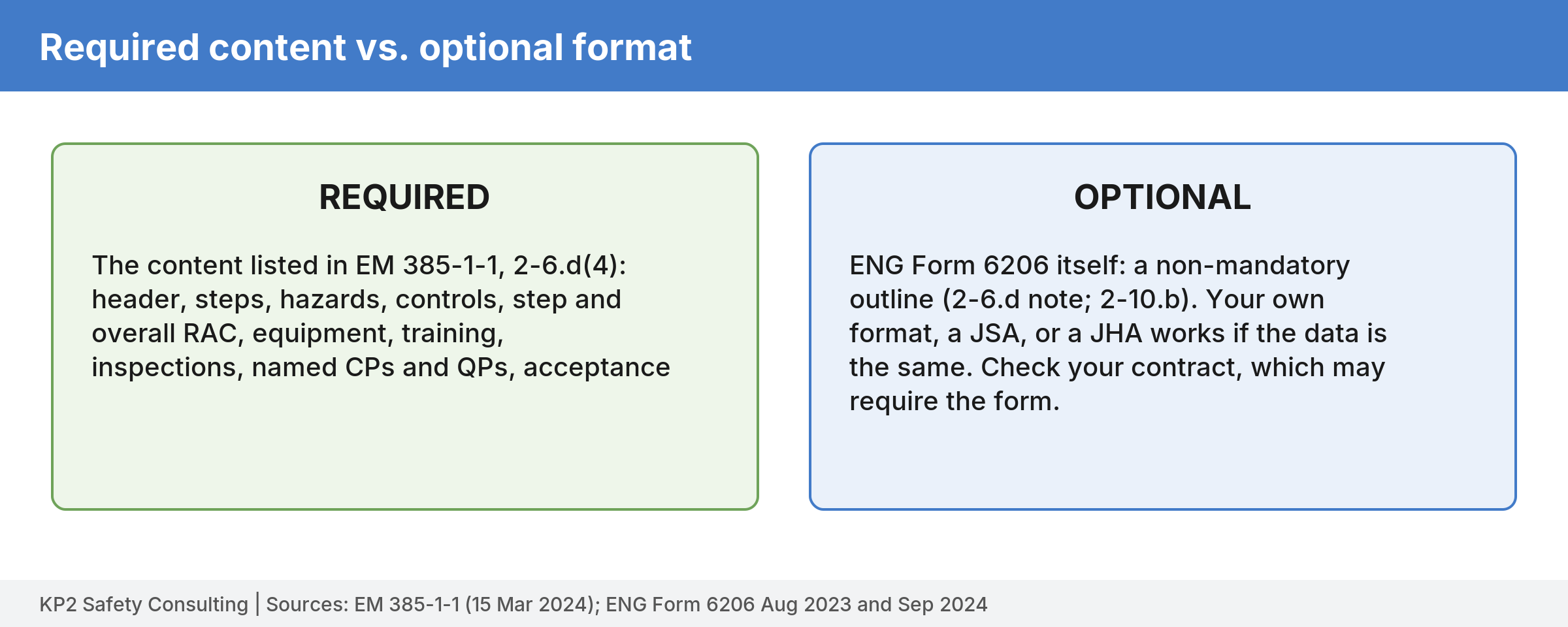
Before anyone panics about form versions, remember that EM 385-1-1 calls ENG Form 6206 a non-mandatory formatted outline of an AHA (note at the end of 2-6.d; 2-10.b). What is mandatory is the content listed in paragraph 2-6.d(4). You can use your own format, and the manual even accepts JSAs and JHAs if they collect the same data (AHA vs JHA covers that in detail). That said, a lot of contracts and reviewers expect to see the Corps form, and when they do, they expect the current edition. Figure 1 sums it up.
How to Tell Which Edition You Have
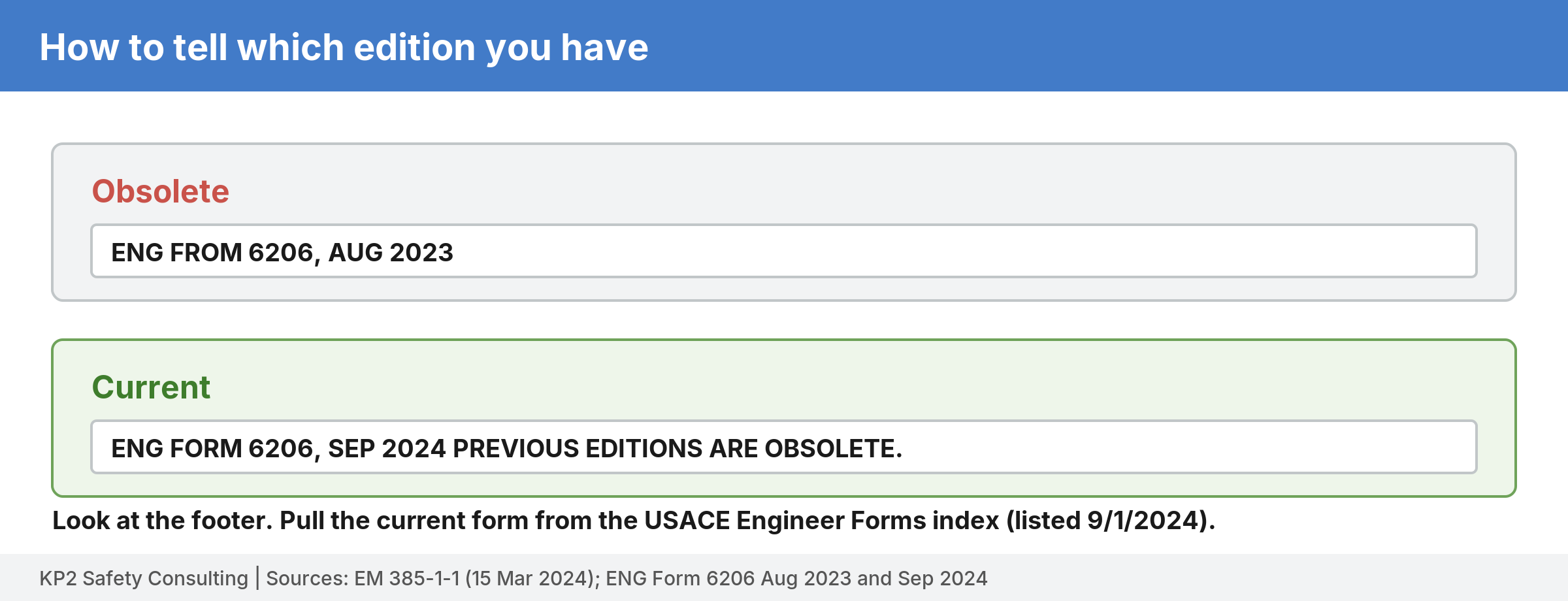
Look at the footer. The current form reads "ENG FORM 6206, SEP 2024" and carries the line "PREVIOUS EDITIONS ARE OBSOLETE." The USACE Engineer Forms index lists ENG 6206 with a publication date of 9/1/2024. The earlier edition reads "AUG 2023" in the footer. One practical warning: when I checked, some USACE web pages that list safety forms still linked to the August 2023 file, so the copy you downloaded from a Corps site is not automatically the current one. Pull it from the Engineer Forms index, or use the copy attached to your solicitation. Figure 2 shows what to look for.
What Changed in the September 2024 Edition
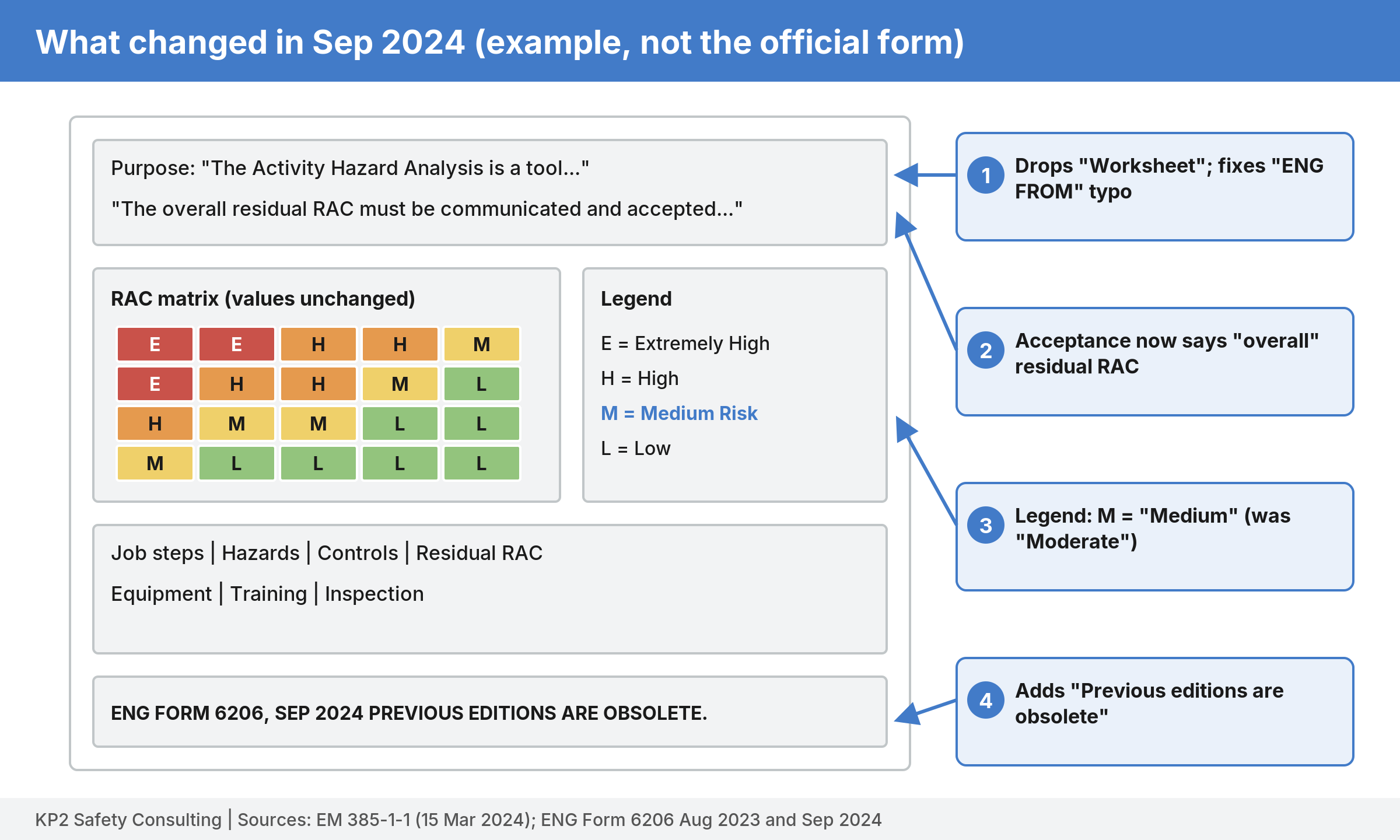
These are the differences I confirmed by comparing the text of the two editions: Figure 3 marks each one on a simplified layout.
"Previous editions are obsolete"
The September 2024 form adds the statement that previous editions are obsolete. If your contract or reviewer requires ENG Form 6206 specifically, this is the line that makes an August 2023 form a problem.
The RAC legend now says "Medium," not "Moderate"
The August 2023 legend defined M as "Moderate Risk." The September 2024 legend defines M as "Medium Risk." That brings the form in line with the manual, which defines the four RAC levels as extremely high, high, medium, and low (2-2.u). It sounds small, but I have seen reviewers circle it.
The acceptance language focuses on the overall residual RAC
The 2023 purpose block said "Residual RAC must be communicated and accepted by the proper approval authority before beginning the activity." The 2024 version says "The overall residual risk assessment code (RAC) must be communicated and accepted by the proper approval authority before beginning the activity." That matches the manual's requirement that the appropriate level of leadership accept the overall residual risk before work starts (2-6.c), and the rule that the overall RAC can be no lower than the highest step RAC (2-6.d(4)(f)). For more on that, see The RAC Matrix Explained.
Cleaner wording and a corrected title block
The purpose statement now calls the document "The Activity Hazard Analysis" instead of "The Activity Hazard Analysis Worksheet," and the 2023 title block typo that read "ENG FROM 6206" is corrected to "ENG FORM 6206."
What Did Not Change
Based on the same comparison, the core of the form is the same, and Figure 4 is the quick checklist:
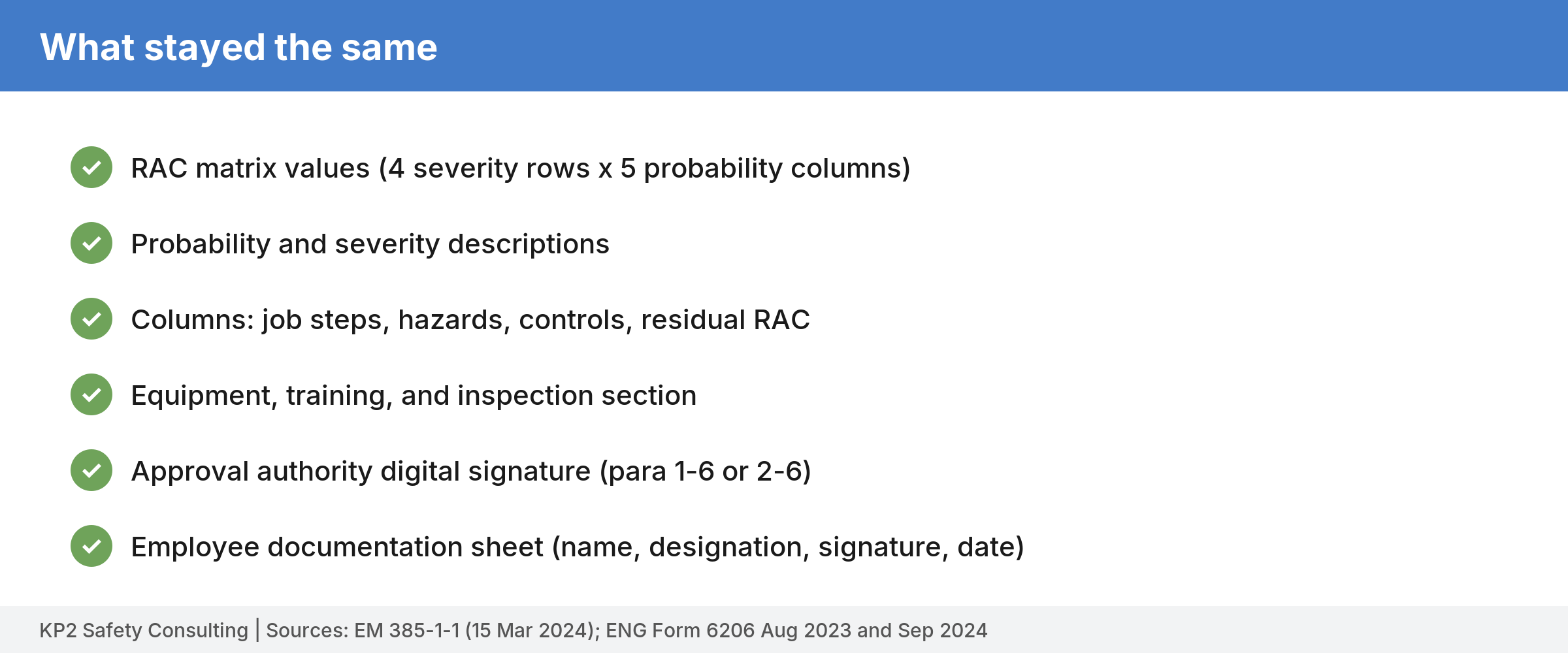
- The RAC matrix values are identical, with four severity rows and five probability columns from frequent to unlikely.
- The probability descriptions and the severity descriptions, including the dollar thresholds and injury descriptions, read the same.
- The working columns are the same: job steps, hazards, controls, and residual RAC, followed by equipment, training, and inspection.
- The approval authority block still calls for a digital signature and still says approval authority is based on the overall RAC according to EM 385-1-1, paragraph 1-6 or 2-6, as applicable.
- The employee documentation sheet still requires each involved worker's name, occupation or designation, signature, and date, which lines up with 2-6.d(2).
Items I Could Not Verify, So Check the Official Form
I want to be straight with you about the limits here. The official USACE file is a fillable form that does not extract cleanly, and the copy I compared was attached to a Corps solicitation. Figure 5 flags the two things I could not confirm from the text:
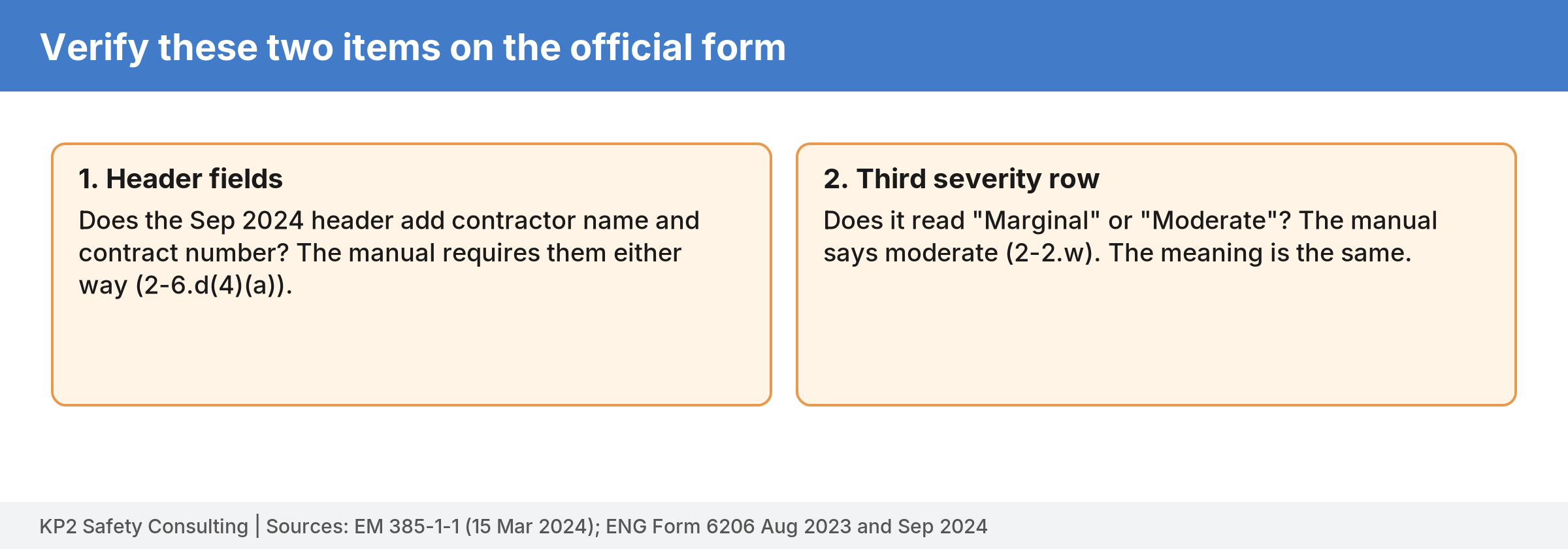
- Whether the header fields changed. EM 385-1-1 requires the contractor name and contract number on every AHA (2-6.d(4)(a)). The August 2023 header had activity, date, location, prepared by, and reviewed by. I could not confirm whether the 2024 header adds contractor and contract fields. Either way, put them on your AHA, because the manual requires them.
- The label on the third severity row. The 2023 form labeled it "Marginal," while the manual calls it "moderate" (2-2.w). I could not confirm which label the 2024 form prints. The row means the same thing regardless.
What This Means for AHAs You Already Have
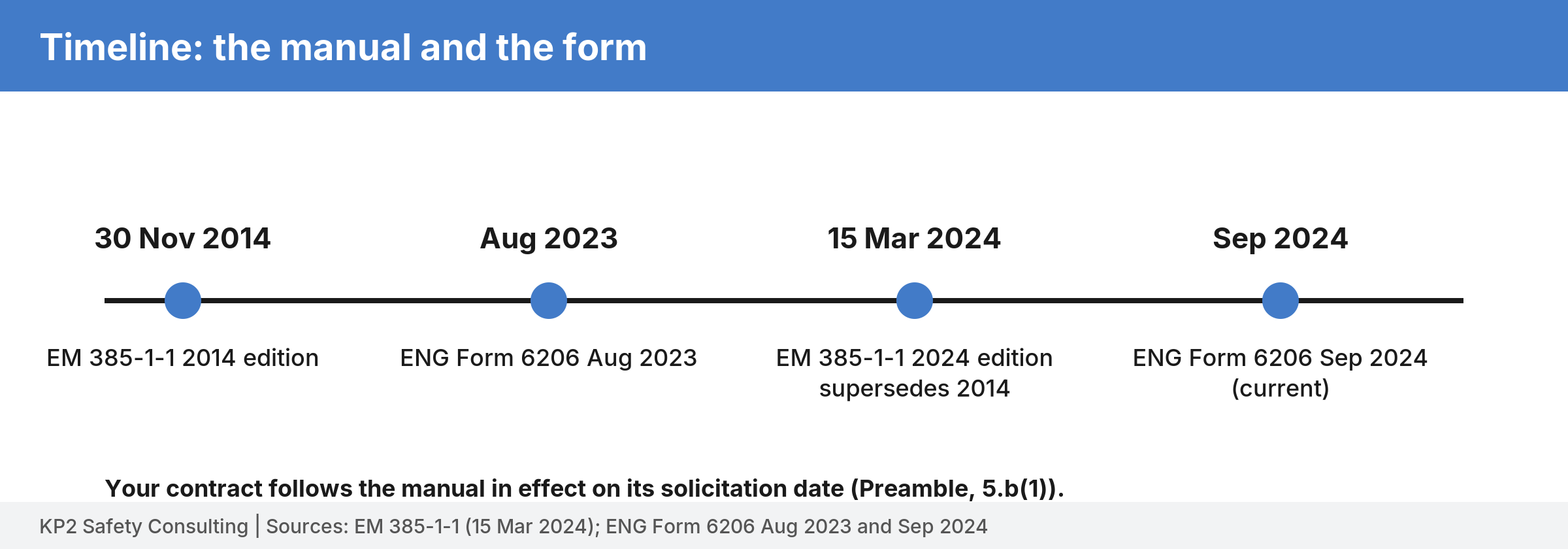
The bigger issue on most of the AHAs I review is not the form edition. It is old content. The 15 March 2024 manual superseded the 2014 edition and renumbered nearly everything, so an AHA that cites 2014 paragraph numbers or a RAC legend that does not match the 2024 matrix tells the reviewer it came out of an old file. Contractors must follow the manual version in effect on the solicitation date, and existing contracts keep the previous edition until completion (Preamble, 5.b(1)), so check which one your contract invokes. Figure 6 puts the dates in order.
When you move an AHA onto the current form, I would check three things. Make sure the AHA lines up with your accepted Accident Prevention Plan, including its risk acceptance process. Make sure every 2-6.d(4) element is present, especially the contractor name, contract number, and the acceptance authority's name and title. Make sure every step has a residual RAC and the overall RAC matches the highest step. And make sure the competent and qualified persons are named, not just listed by title, with proof of qualification (2-6.d(4)(g)). My article on how to write an AHA walks through every element.
FAQ
Is ENG Form 6206 required on USACE jobs?
No. EM 385-1-1 calls it a non-mandatory outline. Some contracts still require it, so check your specs. The 2-6.d(4) content is always required.
What is the current edition of ENG Form 6206?
September 2024, listed on the USACE Engineer Forms index with a 9/1/2024 publication date. It states that previous editions are obsolete.
Did the RAC matrix change?
No. The matrix values and the severity and probability descriptions are the same as the August 2023 edition. The legend now says Medium instead of Moderate.
Do I have to rewrite my existing AHAs?
Not because of the form alone. Update them if they cite the 2014 manual, are missing required content, or if your contract or reviewer requires the current form.
Need AHAs on the Current Standard?
The KP2 AHA Library has more than 200 pre-built AHAs written to the 2024 EM 385-1-1 or OSHA 1926, including excavation, concrete, and steel erection, all customized with your project information. Download the free sample AHA to see the format, and if you want me to look over a set before you submit, email [email protected] or call 410-216-4424.